Contents
The situation
AI entered HR through everyday use before it entered procedures. According to INSEE (in French), France's national statistics office, 18% of companies with 10 or more employees used an AI technology in 2025, and 58% of those with 250 or more. In hiring, Apec (in French), the French executive employment agency, found that 8% of companies that hired a manager or professional in 2025 used AI to do so, mostly to draft job postings.
Training HR teams is therefore not a technical project: it is what keeps decisions about people under control, explainable and lawful.
The legal framework
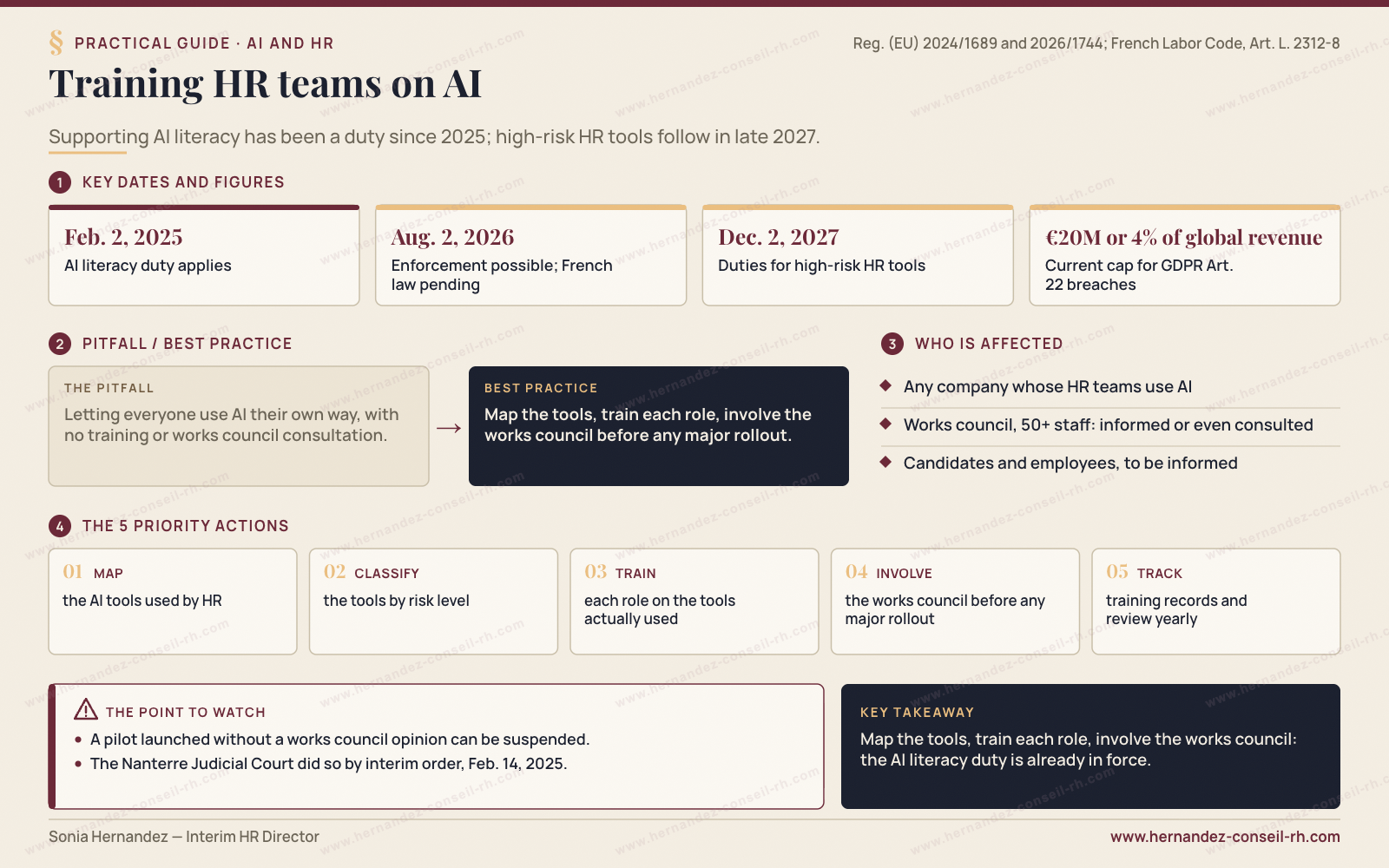
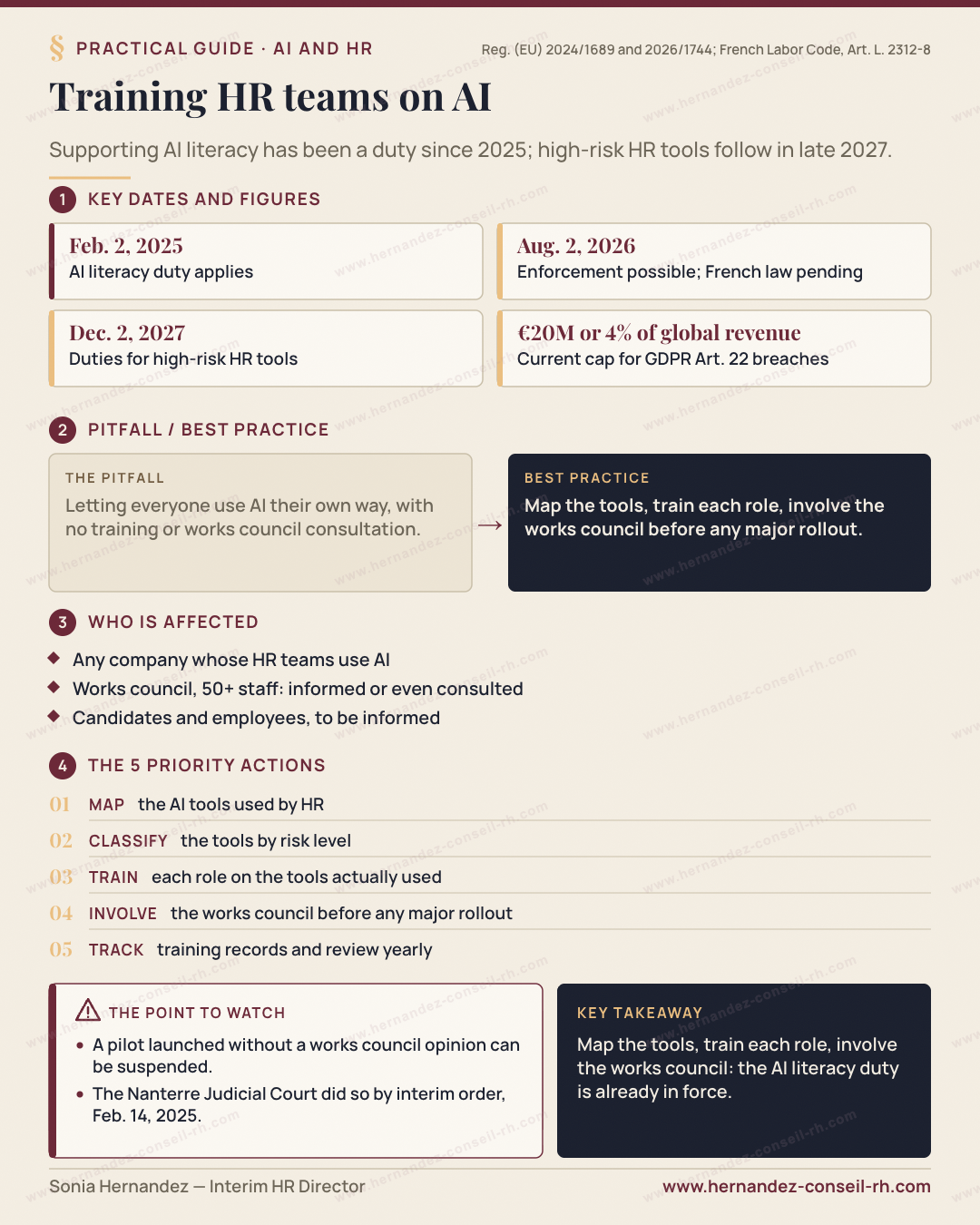
The AI literacy duty
Article 4 of Regulation (EU) 2024/1689 on artificial intelligence has applied since February 2, 2025. Regulation (EU) 2026/1744 of July 8, 2026 (the "Digital Omnibus on AI") rewrote it: companies that use AI systems "take measures to support the development of AI literacy" of their staff and of other people who use these systems on their behalf, such as temporary workers or a recruitment firm, taking into account their knowledge, experience and the context of use. The duty does not require a specific level of AI literacy for each individual.
According to the European Commission's FAQ:
- no certificate is required, and an internal training record can document it,
- simply asking staff to read the tools' instructions is often insufficient
- and national authorities have been able to enforce the duty since August 2, 2026.
HR tools classified as "high-risk"
Annex III of the Regulation classifies as high-risk the AI systems used:
- to recruit or select people: targeted job ads, screening applications, evaluating candidates
- and to make decisions on working conditions, promotion or termination, allocate tasks based on behavior or personal traits, or monitor and evaluate performance and behavior.
A tool limited to a narrow procedural task may fall outside this classification, unless it profiles people (Article 6 of the Regulation). From December 2, 2027, the date set by Regulation (EU) 2026/1744 to replace August 2, 2026, employers that deploy a high-risk tool will have to (Article 26 of the Regulation):
- assign human oversight to people with the necessary competence, training and authority,
- monitor how the tool operates and keep its logs for at least six months,
- inform employee representatives and affected employees before putting the system into service
- and inform the people subject to a decision made or prepared by the system.
These people will also be able to obtain an explanation of the tool's role in the decision (Article 86 of the Regulation).
Inferring employees' emotions in the workplace from their voice or face, by contrast, has been prohibited since February 2, 2025, except for medical or safety reasons (Article 5 of the Regulation).
French employment law
- Train: employers must adapt employees to their jobs and maintain their employability, "in particular in light of changes in jobs, technologies and organizations" (Article L. 6321-1 of the French Labor Code).
- Involve the works council (CSE) in companies with 50 or more employees:
- consult it on the introduction of new technologies (Article L. 2312-8 of the French Labor Code),
- inform it, before use, of hiring assessment methods and automated personnel management systems and of any change to them, and consult it on tools that monitor employees' activity (Article L. 2312-38 of the French Labor Code)
- and consult it every year, unless an agreement sets another frequency, on social policy, including the training program (Article L. 2312-26 of the French Labor Code).
- Inform candidates and employees of the hiring and assessment methods used on them, which must be relevant to their purpose; no data collection tool may be hidden from them (Articles L. 1221-8, L. 1221-9, L. 1222-3 and L. 1222-4 of the French Labor Code).
- Prevent discrimination: a tool that reproduces bias can lead to excluding a candidate or disadvantaging an employee on prohibited grounds (Article L. 1132-1 of the French Labor Code).
- Protect personal data:
- a decision with legal or similarly significant effects, such as rejecting an application, cannot, subject to exceptions, be based solely on automated processing, and the person may obtain genuine human intervention (Article 22 of the GDPR, CNIL page in French)
- and a data protection impact assessment is required for processing that profiles people for HR management, such as an algorithm selecting candidates (CNIL list, in French).
Step-by-step method
- Map current uses (first month). With IT and the data protection officer, list for each tool:
- what it does,
- the data it processes
- and the decisions it prepares or influences.
- Classify tools by risk. Separate writing assistance, tools that affect decisions about people (Annex III) and prohibited uses, such as inferring emotions.
- Carry out the impact assessment with the data protection officer for tools that profile candidates or employees.
- Define the roles to train, since training depends on the role:
- all HR staff: how AI works, its limits and biases, data confidentiality,
- recruiters and career managers: human oversight of decisions, informing candidates and employees
- and HR leaders: legal framework, the works council's role, selecting and overseeing vendors.
- Build the program into the skills development plan, with practical cases drawn from the tools actually used rather than generic training.
- Involve the works council before any major rollout (companies with 50 or more employees), including a pilot phase, presenting the tools, their effects on work and the training plan; disclose in advance any change to a hiring or automated personnel tool.
- Set usage rules: a charter or internal policy, data banned from consumer AI tools, and human validation of any decision about a person. A charter or policy that imposes general and permanent obligations follows the work rules procedure: works council opinion, notice to the labor inspectorate and publication (Articles L. 1321-4 and L. 1321-5 of the French Labor Code).
- Keep records and update them: a register of completed training, and an annual review of tools and training content.
Common pitfalls
- Testing without consulting. In interim proceedings, the Nanterre Judicial Court held that a "pilot phase" was already a first implementation and suspended the rollout until the works council consultation was completed (Nanterre Judicial Court, February 14, 2025, No. 24/01457, discussed by CMS Francis Lefebvre, in French).
- Repurposing a general-purpose tool to screen applications or evaluate employees: from December 2, 2027, the company may be treated as the provider of a high-risk system and bear the provider obligations (Article 25 of the Regulation).
- Relying on the vendor's instructions, which the European Commission considers often insufficient to train users.
- Letting the tool decide alone on rejecting an application or on an evaluation: this breaches Article 22 of the GDPR, subject to exceptions, and creates a discrimination risk.
- Entering employee or candidate personal data into a consumer AI tool without contractual safeguards.
- Forgetting candidates and evaluated employees, who must be informed of the methods used on them.
Checklist
- inventory of the AI tools used by HR,
- classification by risk,
- impact assessment for profiling tools,
- training program by role, included in the skills development plan,
- works council information and consultation before any major rollout,
- written and circulated usage rules,
- information for candidates and employees
- and a training register, updated every year.
In-depth analysis
The legal framework in detail
Article 3 of Regulation (EU) 2024/1689 defines AI literacy as the skills, knowledge and understanding that allow people to deploy AI systems in an informed way and to be aware of the opportunities, risks and possible harm they can cause.
The rewrite of Article 4 by Regulation (EU) 2026/1744, published in the Official Journal of the European Union on July 24, 2026, changes the nature of the duty without removing it:
- before, companies had to ensure, "to their best extent," a sufficient level of AI literacy,
- now, they must take measures to support its development, with no duty to reach a specific level for each individual
- and the European Commission must publish practical examples, with the Commission and Member States supporting companies, especially SMEs.
Article 4 carries no specific EU fine: each Member State sets the applicable penalties (Article 99 of the Regulation). In France, the EU-law adaptation bill, passed at first reading by the Senate on February 18, 2026, makes the CNIL, the French data protection authority, the supervisory authority for high-risk employment and hiring AI systems; it has not yet been finally adopted.
For high-risk tools already in service before these rules apply, the Regulation applies only if their design is significantly changed (Article 111 of the Regulation): a significant new version can therefore bring an existing tool under the new obligations.
What French employment law already requires
Even before the Regulation, the French Labor Code requires employers to train, inform and consult:
- the duty to adapt employees to their jobs and maintain their employability in light of changing technologies (Article L. 6321-1 of the French Labor Code),
- works council consultation on the introduction of new technologies (Article L. 2312-8 of the French Labor Code), with the option of appointing an accredited expert (Article L. 2315-94 of the French Labor Code)
- and prior information of the works council on hiring assessment methods and automated personnel management systems, and its consultation on tools that monitor employees' activity (Article L. 2312-38 of the French Labor Code).
What practitioners say
- A pilot is not a mere experiment (C. Froger-Michon, CMS Francis Lefebvre, April 14, 2025, in French). Commenting on the Nanterre interim ruling, the author notes that the judge saw the pilot not as a mere experiment needed to present a finished project but as a first implementation, so a pilot phase does not necessarily avoid consultation.
- Effects matter more than technology (C. Froger-Michon and V. Goux, CMS Francis Lefebvre, April 13, 2026, in French). Courts look at a tool's effects on working conditions and HR processes rather than its technology: a simple update with no new function may not require consultation, while a skills management tool does.
- Build AI into the training plan (Victor Mollet, attorney, CCI Paris Île-de-France, August 22, 2025, in French). The author advises including AI training in the skills development plan and setting usage rules by agreement or charter, after consulting the works council.
- Training tailored to the role (European Commission, FAQ updated October 20, 2026). No standard training is required: its content depends on each person's role and on the risk of the tools. For human oversight of high-risk systems, the training required by Article 26 will remain essential from December 2, 2027.
Special cases
- Consumer generative AI tools. They fall under the AI literacy duty as soon as they are used at work. If they are used for decisions about people, such as screening applications, the company may, from December 2, 2027, be treated as the provider of a high-risk system and bear the provider obligations (Article 25 of the Regulation).
- AI features added by an HR software vendor. An update that adds a new function, such as automatic screening or profile generation, may require works council consultation; a mere technical change may not, but any change to a hiring or automated personnel tool must be disclosed to the council in advance (Article L. 2312-38 of the French Labor Code).
- Companies with fewer than 50 employees. Works council consultation on new technologies does not apply. The AI literacy duty, information for candidates and employees and the GDPR do; and, from December 2, 2027, informing employees and affected people about a high-risk tool will apply to all employers.
- Groups. A tool rolled out by the parent company remains subject, in France, to information and consultation of the central works council and, where relevant, establishment-level works councils, or even the European Works Council for a cross-border project.
Financial exposure
- Prohibited practice, such as inferring employees' emotions: up to €35 million or 7% of global annual revenue, whichever is higher, and whichever is lower for SMEs (Article 99 of Regulation (EU) 2024/1689).
- Breach of the obligations of employers that deploy a high-risk tool, from December 2, 2027: up to €15 million or 3% of global annual revenue, under the same rule, with the lower figure also applying to small mid-caps (Article 99, as amended by Regulation (EU) 2026/1744).
- Personal data: up to €20 million or 4% of global annual revenue for a breach of Article 22 of the GDPR.
- Obstructing the works council, by rolling out a tool without consultation: a €7,500 fine, and up to €37,500 for a company (Article L. 2317-1 of the French Labor Code), plus any suspension of the rollout a court may order.
The employee representatives' perspective
For the works council, AI in HR processes opens three avenues:
- prior consultation on the tools and their effects on work,
- appointing an accredited expert when new technologies are introduced
- and monitoring the training plan during the consultation on social policy.
For employers, the best response is to involve the works council from the design stage: present the tool inventory, their purposes, the human oversight safeguards and the training program. A project explained early rolls out faster than one suspended by a court.
Cross perspectives
The data protection officer's view
The work starts with the inventory: which personal data each tool processes, where they are hosted and for what purpose. For tools that profile candidates or employees, an impact assessment is required; for consumer AI tools, the data protection officer checks the contractual safeguards before any personal data are entered.
The CFO's view
AI training belongs in the skills development plan. The CFO builds works council consultation time and the impact assessment into the cost of every HR tool project: planning for them costs less than a suspended rollout.
The occupational physician's view
The occupational physician looks at how these tools affect the teams' work: heavier workloads, loss of autonomy, a feeling of being monitored. These effects belong in the occupational risk assessment and tie in with works council consultation on new technologies that change working conditions.
Sonia Hernandez, Interim HR Director — November 9, 2026
General information current as of November 9, 2026; it does not constitute legal advice.