Contents
The issue
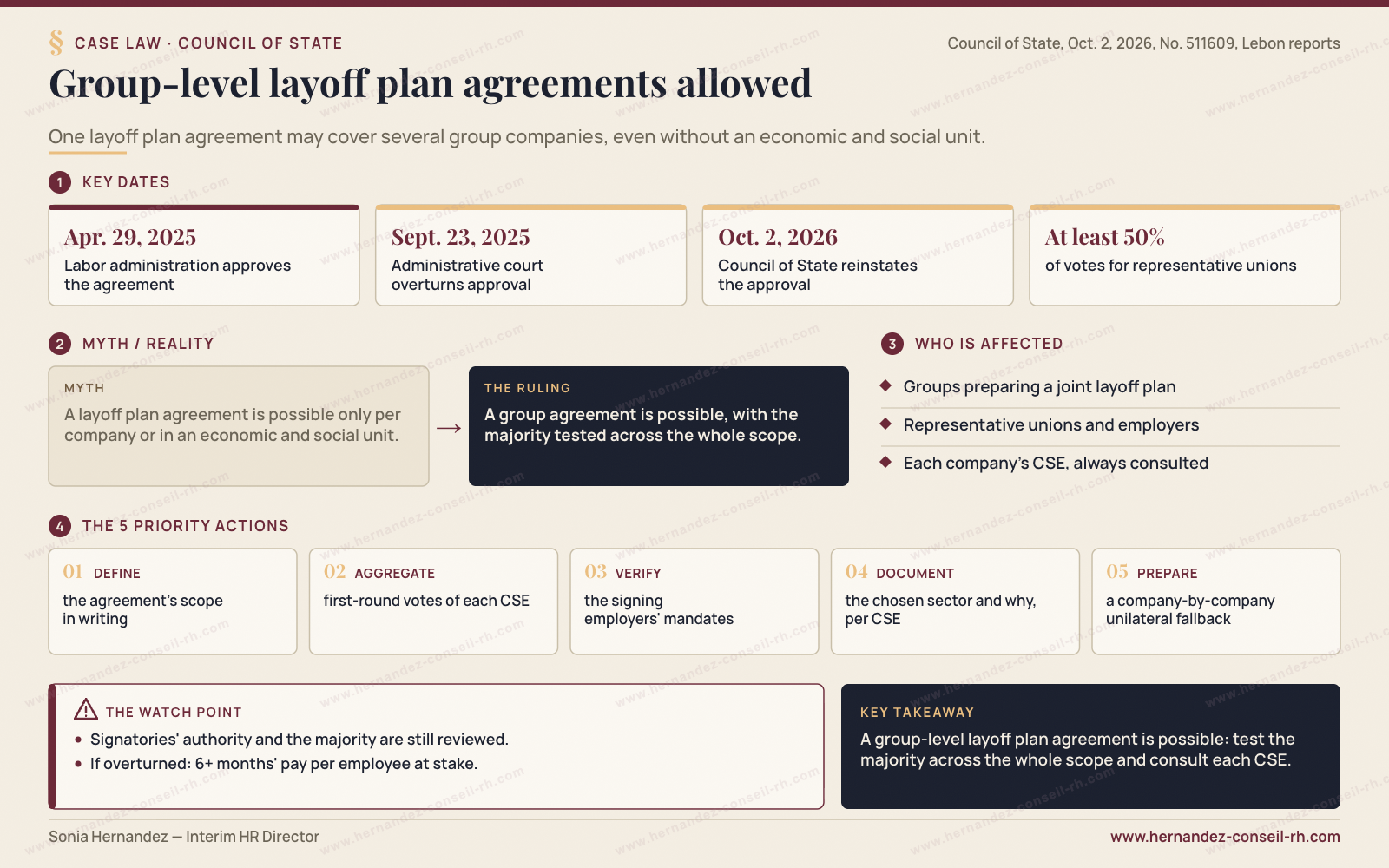
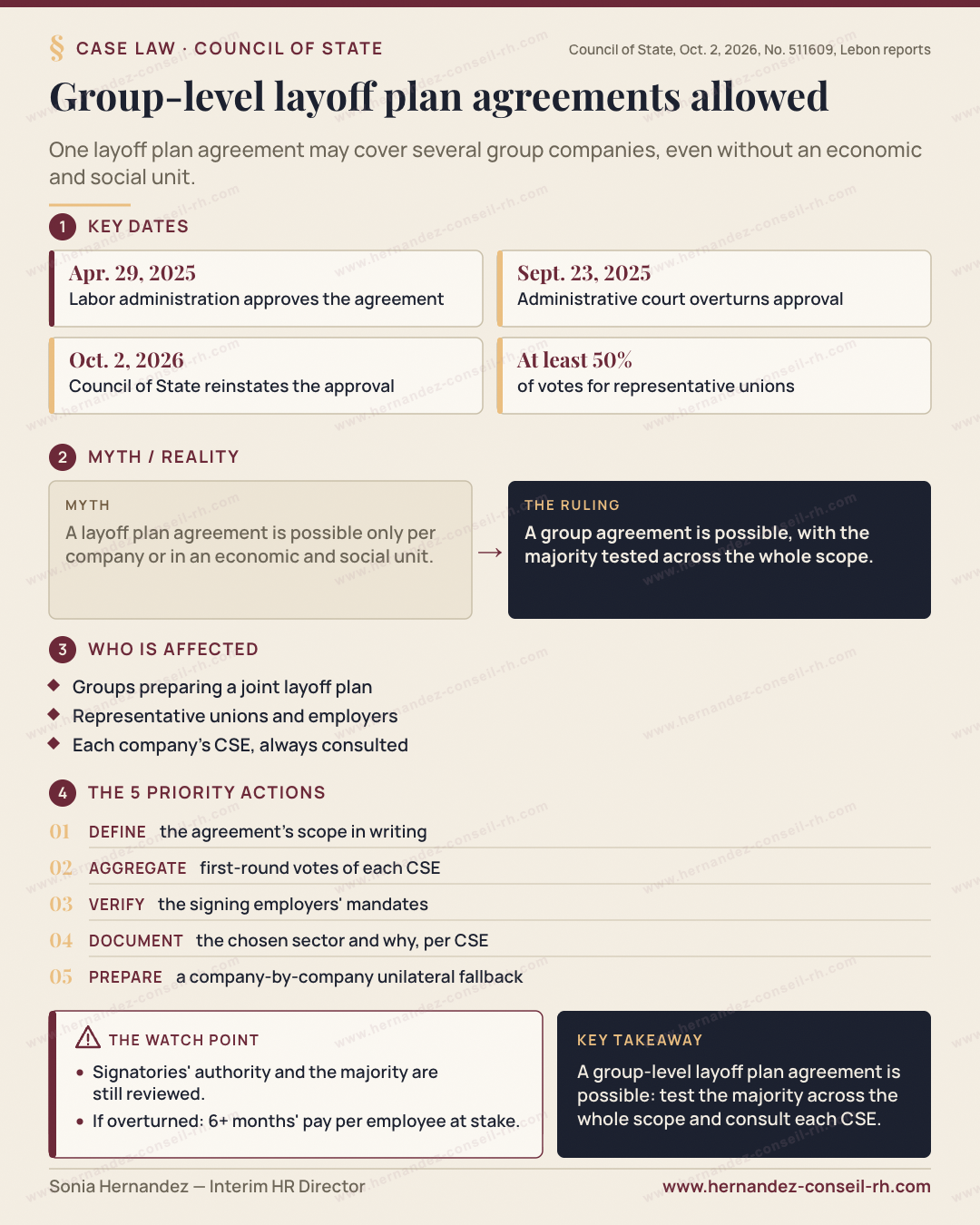
Since 2013, the content of a French layoff plan (PSE) can be set by a majority collective agreement, which is then approved by the labor administration, today the regional office known as the DREETS. However, Article L. 1233-24-1 of the French Labor Code (in French) refers to "companies" with 50 or more employees and requires signature by representative unions that won at least 50% of the votes cast for representative organizations in the first round of the last works council (CSE) election. When a restructuring affects several subsidiaries, groups hesitated between one agreement per company and a single agreement.
In the case at hand, eight retail companies within the same group had signed a single majority agreement, approved by the Hauts-de-France DREETS on April 29, 2025. The Lille administrative court overturned that approval on September 23, 2025, in part because the companies did not form a UES. The Douai administrative court of appeal upheld the annulment on January 7, 2026, relying on the trial court's second ground, relating to works council information.
In a decision of October 2, 2026, No. 511609 (in French), the Council of State, France's highest administrative court, sets aside the appeals court ruling insofar as it dismissed the appeal, then the trial court's judgment insofar as it annulled the approval, dismisses the challenges and reinstates the approval. It holds that a layoff plan agreement may be signed at group level, with majority and representativeness assessed across all the companies within the agreement's scope.
What is at stake
Legal
The Council of State reads Article L. 1233-24-1 of the French Labor Code together with the group agreement rules: Article L. 2232-30 of the French Labor Code (in French) (scope covering all or part of the group's companies), Article L. 2232-31 of the French Labor Code (in French) (who negotiates) and the first paragraph of Article L. 2232-33 of the French Labor Code (in French), which allows any company-level negotiation to be held at group level. The decision also clarifies the DREETS review under Article L. 1233-57-2 of the French Labor Code (in French):
- works council information covers the business sector chosen and the reasons for that choice,
- whether that sector is well founded is for the dismissal judge alone,
- consultation on environmental consequences under section III of Article L. 2312-8 of the French Labor Code (in French) falls outside the DREETS review
- and, on health and safety, the DREETS gives particular weight to measures written into the majority agreement.
Labor relations
Bargaining takes place at a single table, but each works council is still consulted on the planned operation. According to the commentators cited below, a union holding the majority in one subsidiary may be bound by an agreement it did not sign if the majority is reached across the whole scope.
Financial
A single agreement harmonizes support measures and avoids the cost of parallel negotiations. Conversely, an approval overturned on any ground other than inadequate reasoning or the absence or inadequacy of the layoff plan entitles employees, absent reinstatement, to at least six months' pay under Article L. 1235-16 of the French Labor Code (in French).
Reputation
A shared plan makes the restructuring easier to follow for employees and public authorities. It also makes it more visible: in this case, more than seventeen months passed between the approval and the final decision.
Who is affected
- groups planning layoffs in several companies that do not form a UES,
- the employer of the controlling company, the natural signatory of a group agreement,
- unions that are representative in the group or across all the companies in scope
- and each company's works council, still consulted on the planned operation and how it will be carried out.
The labor administration is also affected: when the plan falls under several regional offices, the competent DREETS for a group agreement is the one where the controlling company has its headquarters, under Article R. 1233-3-5 of the French Labor Code. That office reviews the majority calculated across the whole scope.
What to do
- define the agreement's scope in writing, listing the companies covered,
- collect the first-round results of each works council's last election and calculate the majority across the whole scope,
- have the agreement signed by the controlling company's employer or by representatives mandated for that purpose by the employers,
- document for each works council the business sector chosen and the reasons for that choice,
- identify health and safety risks and write the prevention measures into the agreement,
- notify the DREETS without delay that bargaining has begun, identifying the office for the controlling company's headquarters
- and prepare a company-by-company unilateral fallback in case bargaining fails.
Points to watch
The Council of State does not explain how to aggregate votes when works council elections took place on different dates. The cautious approach is to use, for each company, the first round of its last election, then add up the votes cast for representative organizations.
Signatories' authority is still reviewed. A claim that a signatory lacked authority can be raised in court; only the complaint that the administration failed to check it is ineffective. On the employer side, Article L. 2232-31 of the French Labor Code requires the controlling company's employer or representatives mandated for that purpose.
The DREETS does not review environmental consultation, but the duty to consult the works council on that point under section III of Article L. 2312-8 of the French Labor Code remains. Likewise, failing to specifically update the written occupational risk assessment (DUERP) did not taint the procedure here, because risks had been identified and measures planned; it is not a general exemption.
In-depth analysis
Scope of the decision
The decision was handed down by the combined 4th and 1st chambers and is published in the Lebon reports; its official summary records the possibility of a group-level layoff plan agreement, with the majority assessed across the whole scope. It relies on Article L. 1233-24-1 of the French Labor Code and on Articles L. 2232-30, L. 2232-31 and L. 2232-33 of the same code. The decision does not cite Article L. 2232-34 of the French Labor Code (in French), whose wording on assessing the rates across all the companies in scope is similar; it refers only to the majority conditions of Article L. 1233-24-1, that is, 50% of the votes cast.
It builds on earlier case law:
- the full-court decision of July 22, 2015, No. 385816 (Heinz) (in French) set the business-sector information rule, repeated almost word for word,
- the full-court decision of the same day, No. 385668 (Pages Jaunes) (in French) upheld the annulment of an approval for lack of a majority, as one signatory was not a union delegate,
- the decision of March 2, 2022, No. 438136 (in French) accepted a layoff plan agreement signed at UES level, by each company or by one of them under an express prior mandate,
- the decision of December 27, 2022, No. 452898 (in French) ruled out, for the approval (homologation) of a unilateral plan, administrative review of consultations based on Article L. 2312-8 of the French Labor Code
- and the decision of March 21, 2023, No. 450012 (in French) defined the two-step review of risk prevention, which the 2026 decision adapts to majority agreements.
In his opinion (in French), the public rapporteur acknowledges real hesitation, as group agreement rules fit poorly with layoff plan rules. He notes, however, that a regulation already designates the competent DREETS for group agreements, Article R. 1233-3-5 of the French Labor Code (in French), and gives priority to freedom of contract.
What practitioners say
Stéphane Bloch, Ogletree Deakins, OD Flash, October 5, 2026. The author identifies three contributions: group agreements without a UES, information limited to the chosen sector and the central role of the majority agreement on health and safety. He sees it as a valuable tool for employers, including for risk prevention (read the article (in French)).
Marie-Françoise Clavel, AEF info, October 5, 2026. The dispatch traces the litigation and details the ownership chart: the three top holding companies, which are not in retail, did not need to appear in works council information (read the dispatch (in French)).
Voltaire Avocats, October 8, 2026. The firm suggests a three-step approach: identify the group under the Commercial Code, define the entities in the same sector and provide their data, nothing more. It considers the group majority agreement a benchmark vehicle (read the article (in French)).
Mathilde Paquelier and Estelle Saboury, BCTG Avocats, October 22, 2026. The authors stress that a union holding the majority in one company may be bound by the agreement and leave open which court can hear a failure to consult on environmental matters. They point out that updating the DUERP is still required (read the article (in French)).
Commentary in law journals, including the Gazette du Palais, is not freely accessible at the time of writing.
Open questions
- how to aggregate votes when the companies' election cycles differ,
- what form the employers' mandate takes when the controlling company does not sign alone,
- what happens if bargaining fails, since no unilateral group-level plan is provided for
- and which court can sanction a failure to consult on environmental matters.
The financial exposure
If the approval is overturned on any ground other than inadequate reasoning or the absence or inadequacy of the layoff plan, each dismissed employee may be reinstated, if both parties agree, or else receive compensation of at least the last six months' pay, on top of severance pay (Article L. 1235-16 of the French Labor Code). If the annulment is based on the absence or inadequacy of the layoff plan, the dismissal procedure is void under Article L. 1235-10 of the French Labor Code (in French).
Hypothetical case: a group agreement covers 300 layoffs, with an average gross salary of 3,000 euros a month. If an annulment for lack of a majority falls under Article L. 1235-16 of the French Labor Code, which is for the dismissal judge to determine, the employer would face a floor of 18,000 euros per employee, or 5.4 million euros, before payroll taxes and legal costs.
The employee representatives' perspective
Works council members and unions have several levers:
- require, in each works council, data on the chosen sector and the reasons for that choice,
- ask the DREETS for an injunction before the approval request is filed, which it must decide within five days under Article L. 1233-57-5 of the French Labor Code (in French),
- check the authority of each signatory, union and employer alike
- and keep challenges to the economic grounds for the dismissal judge.
The employer's best response is to make the majority calculation verifiable by attaching each company's election results, to attach the employers' mandates and to explain the choice of business sector in writing.
Cross perspectives
The CFO's view
For the chief financial officer (CFO), the economic information owed to works councils concerns the chosen business sector; in this case, the top holding companies outside that sector did not need to be documented. The six-month pay floor under Article L. 1235-16 of the French Labor Code measures the financial exposure if the approval is overturned.
The works council expert's view
For the expert, the decision sets the object of the analysis: the information the employer provides must cover the economic situation of the chosen sector and the reasons for that choice. Incomplete information on that sector can block approval, as the 2015 Heinz decision showed in the context of a unilateral plan.
The employee-side lawyer's view
The debate over the relevance of the business sector is not closed: it moves to the dismissal judge, before whom each employee can bring a claim. Checking signatories' authority remains a useful argument against the approval.
Sonia Hernandez, Interim HR Director — November 9, 2026
General information current as of November 9, 2026; it does not constitute legal advice.