Contents
The issue
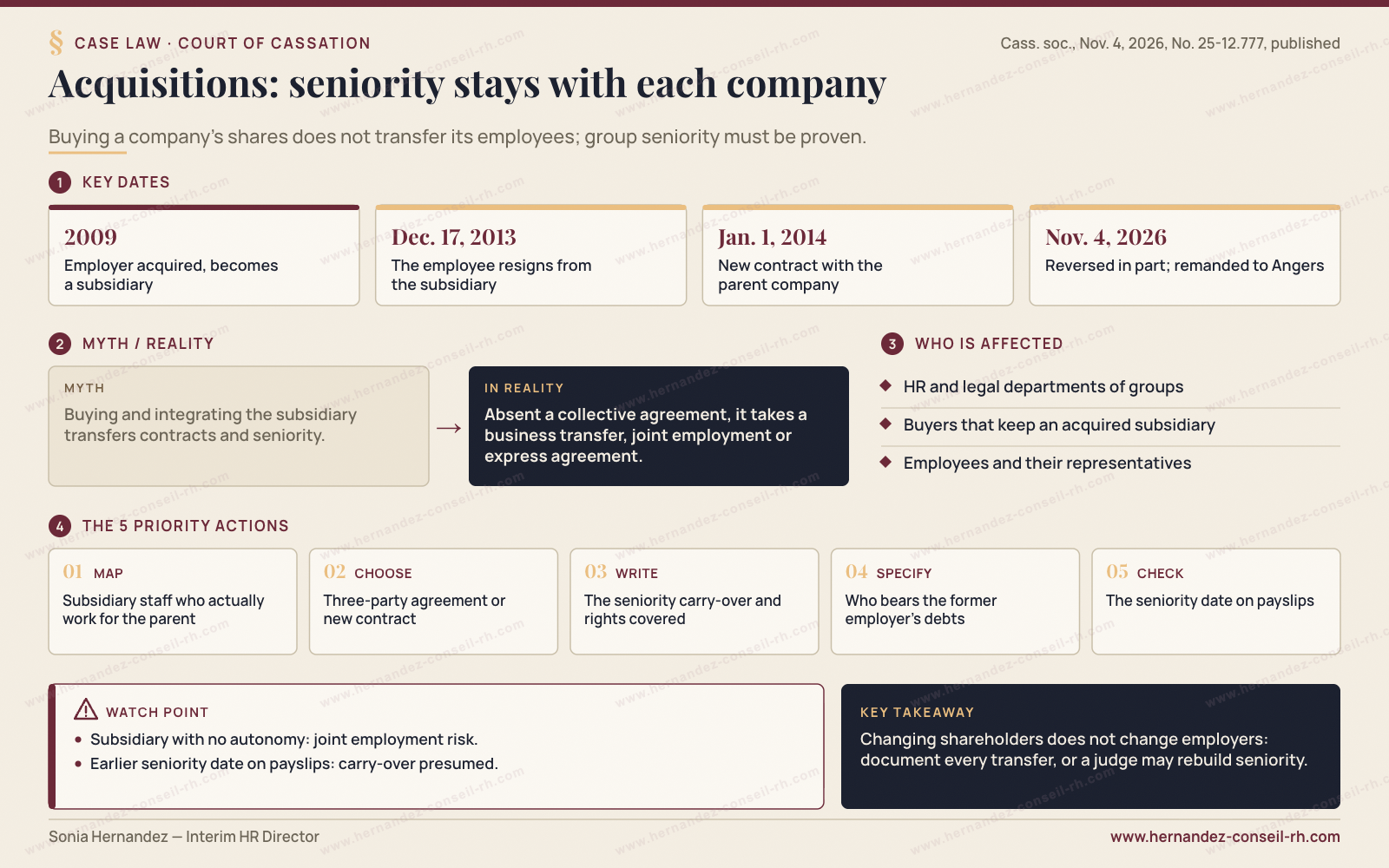
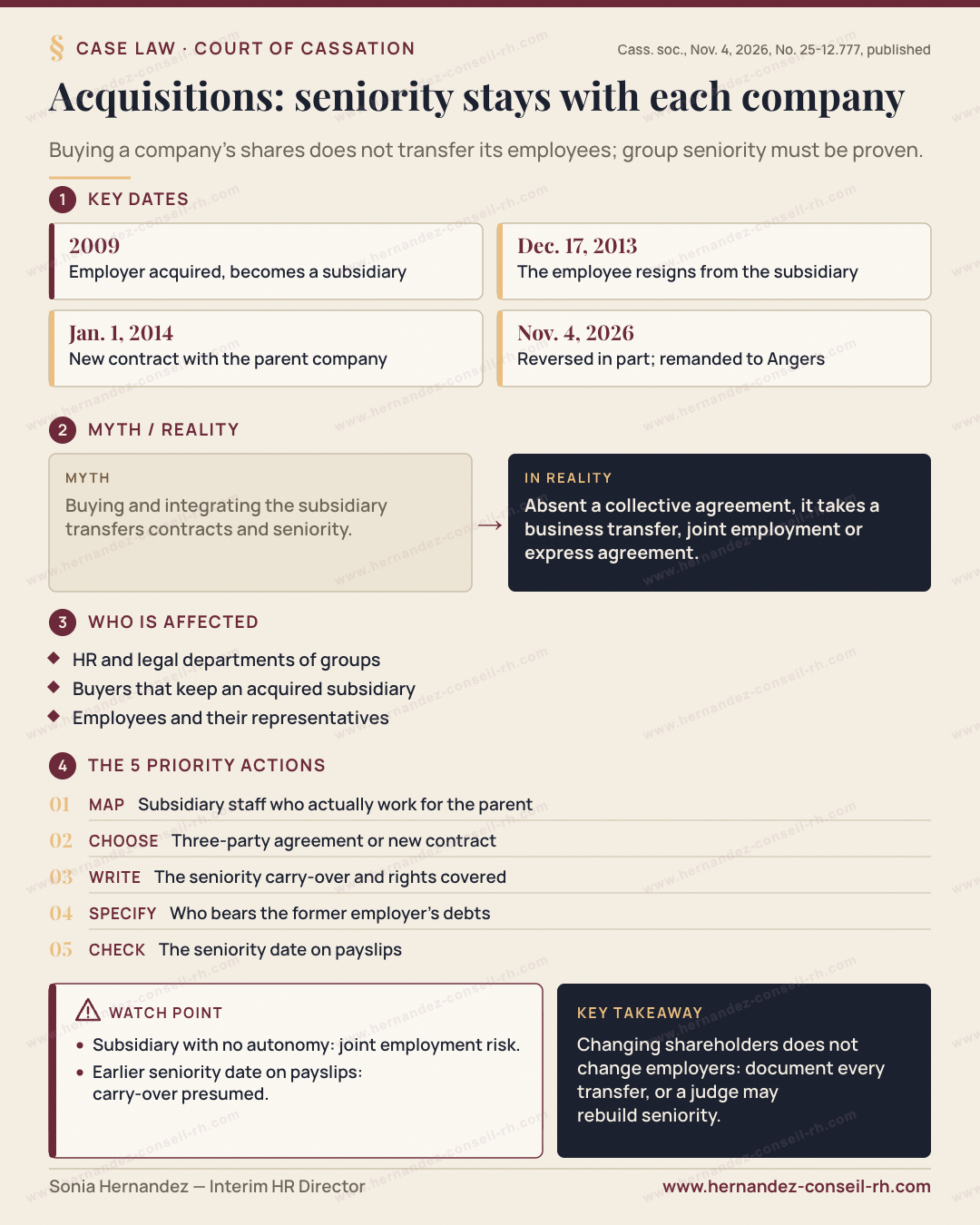
An employee was hired in 1994 as an accounting assistant by a company. In 2009, that company was acquired by another and became its subsidiary. The employee then worked largely for the whole group, with no amendment to her contract. On December 17, 2013, she resigned from the subsidiary and, three days later, signed a contract with the parent company as head of administration and finance, effective January 1, 2014, with no clause carrying over her seniority. After an occupational illness, a request for judicial termination of her contract and a dismissal for medical unfitness in 2021, her seniority date became decisive for the amount of her severance.
The Rennes Court of Appeal had set seniority at 1994, pointing to the subsidiary's integration into the group: shared purchasing and invoicing tools, common IT management and an employee mostly assigned to group-level work. It concluded that her contract had been automatically transferred under Article L. 1224-1 of the French Labor Code (in French).
The Court of Cassation, France's highest court for civil and employment matters, overturned that reasoning in its labor chamber ruling of November 4, 2026, No. 25-12.777 (in French). A mere acquisition of shares does not change the company's legal situation: employment contracts do not pass to the new shareholder. And, absent collective or contractual provisions to the contrary or joint employment, successive contracts with companies of the same group do not allow an employee to claim seniority earned in one of them. The lower court had to establish one of three situations:
- the transfer of an autonomous economic entity whose business is continued or resumed,
- joint employment, meaning the parent company's permanent interference in the subsidiary's economic and HR management, leading to the subsidiary's total loss of autonomy
- and the express agreement of all parties to the transfer of the employment contract.
Because it did not, the ruling was set aside on seniority, on the amounts that depend on it and on the working-time claim, and the case was sent to the Angers Court of Appeal. The judicial termination of the contract on grounds attributable to the employer was not affected.
What is at stake
Legal
The ruling draws a clear line between corporate law and labor law: a new shareholder is not a new employer. By citing Article L. 1221-1 of the French Labor Code (in French) and former Article 1134 of the French Civil Code, the Court recalls that group seniority is never presumed: it stems from a collective agreement, a contract or joint employment. The ruling also settles a jurisdiction issue: compensation for unused mandatory rest time belongs to the labor court, whereas damages for breaches of working-time limits, when relied on to establish the employer's inexcusable fault in an occupational illness case, belong to the social security division of the civil court.
Labor relations
For employees of an acquired company, resigning and being rehired by the parent company can erase decades of seniority. The sense of unfairness runs high when the job, the office and the team stay the same.
Financial
Seniority drives statutory severance, the cap on damages for unfair dismissal and collectively agreed bonuses. Here, the ruling sets aside EUR 15,851.56 of special severance pay and EUR 106,000 in damages.
Reputational
A poorly documented transfer fuels long litigation: a labor court claim in 2020, an appellate ruling in 2025, a Court of Cassation ruling in 2026 and now a retrial. The group's employer brand rarely comes out unscathed.
Who is affected
The ruling primarily concerns HR and legal departments in groups growing through acquisitions, in particular:
- buyers that keep the acquired company as a subsidiary and then pool its support functions,
- groups that move employees from a subsidiary to the parent company through resignation and rehiring,
- sellers and buyers negotiating the employment warranties of a deal
- and employees and their representatives, who need to know which company actually employs them.
What to do
Before and after an acquisition, six steps help secure internal transfers:
- after closing, map the subsidiary's employees who actually work for the parent company and regularize their status through a contract amendment or a formal secondment,
- choose the instrument for each transfer: a three-party agreement continuing the contract, with seniority carry-over spelled out in writing, or a new contract assumed as such,
- avoid the "resign and rehire" pattern when the group initiates the move, as it weakens both the termination and the seniority date,
- define in writing the scope of any seniority carry-over: which rights, which start date and whether the new employer takes on the former employer's liabilities,
- align the seniority date on payslips with the contract, since it creates a presumption of carry-over
- and negotiate a group-wide agreement on internal mobility setting common seniority rules.
Watch points
The ruling is not a blank check. Deep integration of a subsidiary can amount to joint employment if the parent company strips it of all autonomy in its economic and HR management. An industry-wide collective agreement or a group agreement may require seniority earned within the group to be counted. An earlier seniority date on payslips creates a presumption of carry-over. Finally, the Angers Court of Appeal may still find one of the three situations, if the facts support it. The rule protects employers who document their decisions, not those who let the facts contradict the contracts.
In-depth analysis
Scope of the ruling
The ruling was issued by a three-judge panel and is designated for publication in the Court's official reports. It cites Articles L. 1224-1 and L. 1221-1 of the French Labor Code and former Article 1134 of the French Civil Code. It follows a consistent line of cases:
- October 20, 2010, No. 08-40.822 (in French), a published ruling, already held that successive contracts within a group do not carry over prior seniority absent a collective agreement, a contract or joint employment, for an employee who resigned from one group company to join another,
- June 13, 2018, No. 17-13.447 (in French) applied the same rule to an employee claiming group seniority for severance purposes,
- November 25, 2020, No. 18-13.769 (in French), a published ruling, defined joint employment as permanent interference in economic and HR management leading to a total loss of autonomy, a test the 2026 ruling applies in turn,
- March 23, 2022, No. 20-21.518 (in French), a published ruling, held that a three-party agreement continuing the contract in another group company does not pass all of the former employer's obligations to the new one, absent express clauses
- and September 13, 2023, No. 22-11.004 (in French) specified that express agreement to a transfer cannot be inferred merely from continued work on the same terms.
The 2026 ruling matters for its acquisition context: it holds that a mere acquisition of shares, even followed by operational integration, does not trigger Article L. 1224-1 of the French Labor Code.
What practitioners say
Since the ruling is very recent, published commentary remains brief; the major subscription journals were not accessible.
Open Lefebvre Dalloz, "Une semaine de jurisprudence sociale à la Cour de cassation," November 9, 2026. The weekly digest (in French) files the ruling under contract performance and draws three lessons from it: seniority, labor court jurisdiction over unused rest time and social security court jurisdiction over working-time breaches relied on for inexcusable fault.
CMS Francis Lefebvre, Camille Baumgarten and Caroline Froger-Michon, June 8, 2022. Discussing the 2022 ruling, the authors (in French) note that French law has no specific legal category for three-party transfer agreements and conclude that employees must pursue prior debts against their former employer.
Éditions Tissot, September 25, 2023. This commentary (in French) on the 2023 ruling highlights the need for express agreement and the role of the collective agreement's own definition of seniority.
Open questions
The Court did not rule out 1994 as the seniority date: it faulted the lower court for looking in the wrong place. Several points remain open:
- whether the employee, assigned to group-level work from 2009 according to the appellate ruling, was in fact subordinate to the parent company before 2014, which would raise the question of an earlier change of employer,
- whether the 2013 resignation, if requested by or made in the interest of the group, could be treated as an agreed transfer
- and how much weight strong operational integration carries when it falls short of the total loss of autonomy required for joint employment.
The Angers Court of Appeal will have to address these issues.
The quantified risk
Two rules depend directly on seniority. Article R. 1234-2 of the French Labor Code (in French) sets statutory severance at one quarter of a month's pay per year up to ten years, then one third beyond; Article L. 1226-14 of the French Labor Code (in French) doubles it for work-related unfitness. Article L. 1235-3 of the French Labor Code (in French) caps unfair dismissal damages at 8 months' pay for 7 years of seniority and 18.5 months for 26 years.
Simplified example: reference salary of EUR 4,000 gross per month, work-related unfitness, a company with at least 11 employees and notice period left aside.
- with 26 years of seniority, special severance reaches about EUR 62,667 and the damages cap EUR 74,000,
- with 7 years, special severance drops to EUR 14,000 and the cap to EUR 32,000
- and the maximum gap therefore exceeds EUR 90,000 for a single employee.
Caveat: if a dismissal for work-related unfitness breaches the duty to seek redeployment, Article L. 1226-15 of the French Labor Code (in French) points to Article L. 1235-3-1 of the French Labor Code (in French): damages are then uncapped, with a six-month floor.
The employee representatives' view
The works council (CSE) is consulted on changes to the company's economic or legal organization under Article L. 2312-8 of the French Labor Code (in French). Its levers:
- requesting, during integration, the list of employees working for other group companies,
- insisting that every transfer goes through a written agreement stating whether seniority carries over
- and bringing mobility into the negotiation on workforce and career planning required by Article L. 2242-20 of the French Labor Code (in French) in groups with at least 300 employees.
The employer's best response is transparency: a group agreement on mobility, concluded under Article L. 2232-31 of the French Labor Code (in French), that sets a single seniority rule takes most of the heat out of future disputes.
Cross perspectives
The CFO's view
The CFO will treat seniority as a hidden liability. In an acquisition, the CFO prices the seniority dates carried over or not, planned transfers and joint employment exposure. Under the 2022 ruling, a seniority carry-over agreed without any clause on prior debts does not pass all of them to the new employer.
The Comp&Ben expert's view
Seniority bonuses, extra leave and collectively agreed severance depend on how each collective agreement defines seniority. The compensation and benefits expert checks those definitions before promising a carry-over, and audits the date printed on payslips, which a September 24, 2025 ruling, No. 24-16.341 (in French), treats as a presumption of carry-over.
The employee-side lawyer's view
The first move is to find a document: a clause, a three-party agreement, a group agreement or a payslip. Failing that, the lawyer will build a joint employment or actual subordination case against the parent company, documenting who set assignments, hours and objectives before the resignation.
Sonia Hernandez, Interim HR Director — November 9, 2026
General information current as of November 9, 2026; it does not constitute legal advice.