Contents
The issue
Many French companies run a group risk benefit plan (incapacity to work, disability and death coverage, known in France as "prévoyance") created by a unilateral employer decision (DUE), while their industry-wide collective bargaining agreement (CBA) also sets up a plan. Article L. 2254-1 of the French Labor Code (in French) makes CBA provisions binding "unless more favorable terms apply." The question is what exactly should be compared: a contribution line, a single risk or the plan as a whole? It comes up in every compliance audit, every post-merger harmonization and every employee challenge to a payroll deduction.
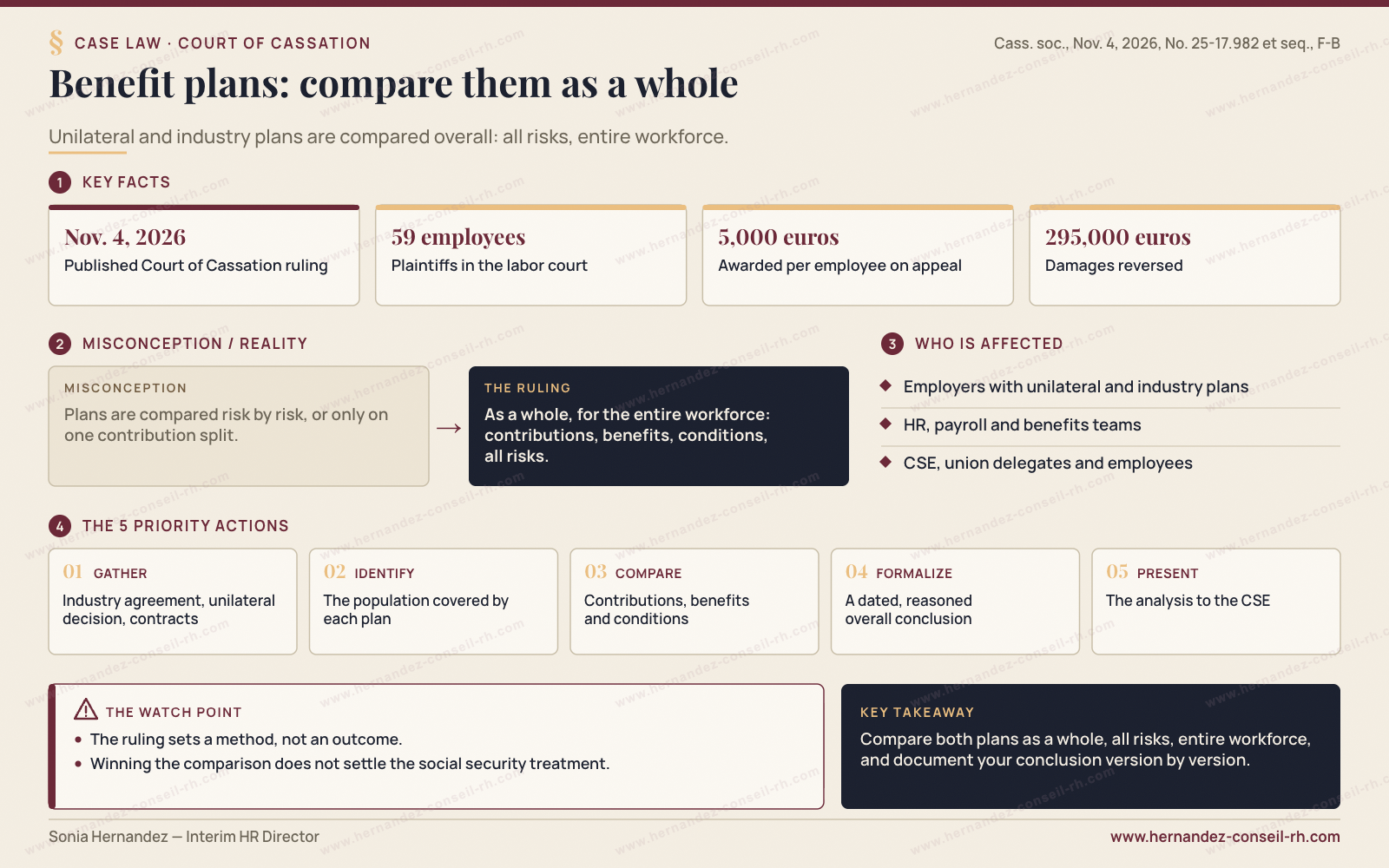
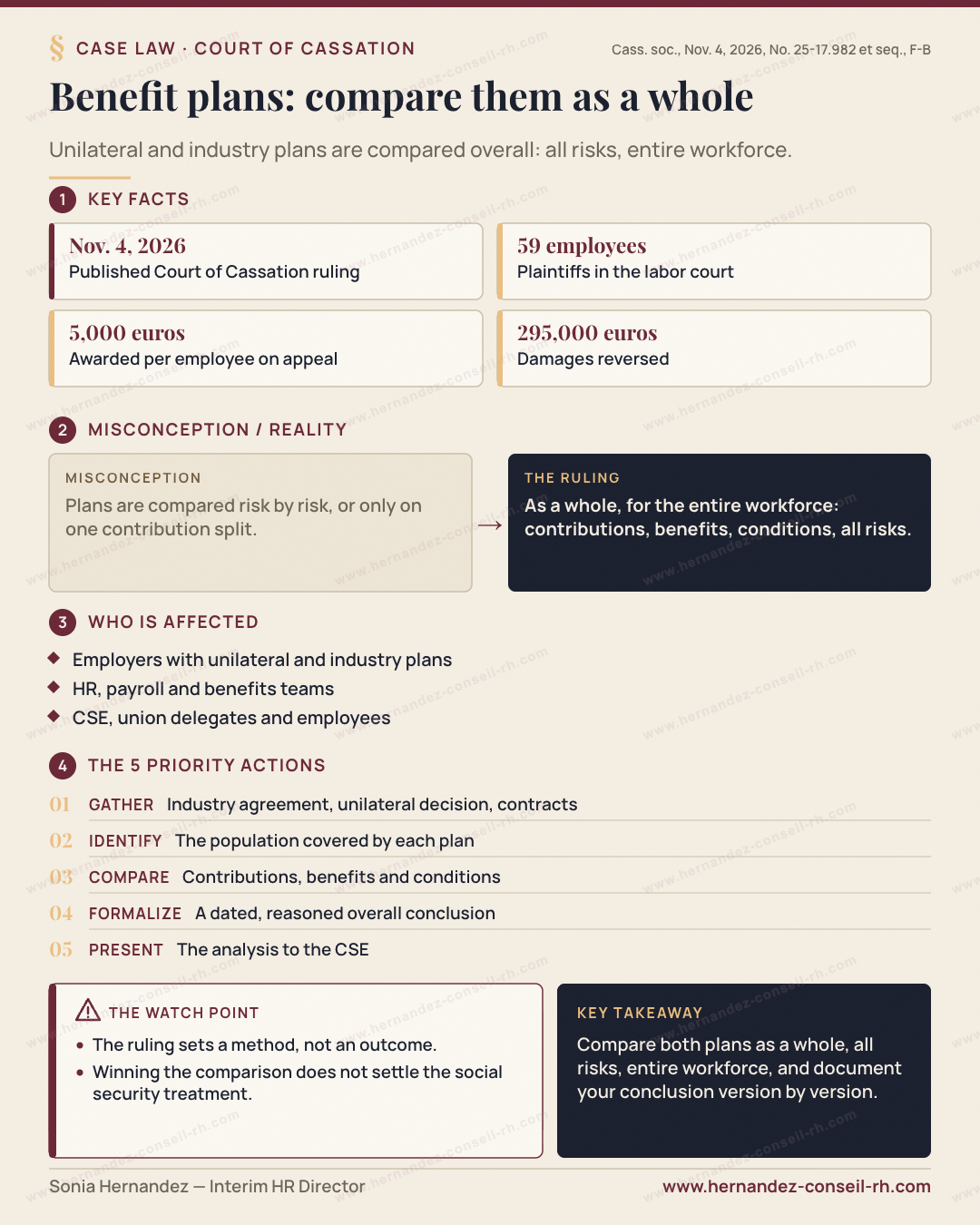
In the case decided on November 4, 2026 by the Court of Cassation, France's highest court for civil and employment matters (No. 25-17.982 and 58 related appeals) (in French), a nonprofit hospital operator was covered by the national CBA for private nonprofit hospitals and care facilities of October 31, 1951. Its Article 13.05 requires the employer to fund the sickness and long-term illness risk in full, while disability and death are funded half and half. The unilateral plan for non-management staff, in place since January 1, 2002, left about 3% of the incapacity contribution to employees, but paid daily benefits with no seniority requirement and better death benefits.
The Versailles Court of Appeal had compared only the cost-sharing split for the incapacity contribution and awarded 5,000 euros to each of the 59 employees. The Court of Cassation reversed: the risks covered by a benefit plan "necessarily have the same cause," and the comparison must be made as a whole, for the entire workforce. The case was sent back to the Paris Court of Appeal. The Court did not say which plan is more favorable.
What is at stake
Legal
The unit of comparison is the entire benefit plan, not each risk taken separately. A hybrid plan cannot be assembled by picking the best clause of each text line by line. The comparison covers funding, benefits and eligibility conditions. The Court thus followed the employer's argument that contributions, their split and benefit amounts must all be weighed together.
Labor relations
An employee contribution that the industry plan does not require remains a sensitive issue for employee representatives. The ruling does not validate it: it requires weighing it against the advantages of the company plan, which calls for dialogue based on shared data. In the case at hand, the social context included a strike and a formal alert by employee representatives.
Financial
The contribution gap was small, but the Court of Appeal had awarded each employee 5,000 euros for the benefit plan breach and a failure to inform, or 295,000 euros for 59 employees. A collective lawsuit costs far more than a correction. Add the management time spent over several years: the labor court case had been filed in October 2019.
Reputational
A benefit plan dispute concerns how employees are protected in case of illness, disability or death. For an employer in the healthcare or social sector, whose employer brand rests on care, the exposure is real, especially as such a case can involve dozens of plaintiffs, 59 in this one.
Who is affected
Directly affected are:
- employers covered by a CBA that sets up a benefit plan and that apply a separate company plan,
- groups that harmonized benefits through a DUE after a merger or a business transfer,
- HR, payroll and benefits teams in charge of compliance audits,
- and the works council (CSE), union delegates and employees who challenge a contribution.
The reasoning applies where a CBA and a DUE overlap; it builds on the Court's general case law on overlapping standards. Nonprofit employers under the October 31, 1951 CBA are the first concerned, but the method is meant to apply in any industry with a benefit plan.
What to do
Checklist to secure a company plan:
- gather the CBA benefit provisions, the DUE and its amendments, the insurance contracts and the plan summaries, version by version,
- identify precisely the population covered by each plan, such as non-management staff,
- compare, for each salary bracket, the contribution rate and its split between employer and employees,
- compare, risk by risk, benefit levels, waiting periods and seniority requirements,
- write up a reasoned, dated overall conclusion, identifying any employees who would gain or lose,
- present the analysis to the CSE and, if the company plan is not more favorable, align the DUE with the industry plan,
- and check with payroll the conditions for the social security exemption of the employer contribution.
This audit brings together HR, payroll and the broker or insurer, who alone hold the benefit schedules and claims data. Its findings must be producible in court, version by version, without after-the-fact reconstruction.
Watch points
- the ruling sets a method, not an outcome: a plan that is less favorable overall is set aside, as a 2019 precedent shows,
- the assessment covers the whole workforce concerned, not each employee individually,
- a contribution gap remains part of the comparison and must be quantified,
- each version of the DUE must be compared with the CBA in force on the same date,
- a DUE requires a written document given to each employee, and delivery must be provable,
- and winning the labor law comparison does not settle the social security treatment of contributions.
In-depth analysis
Scope of the ruling
Handed down by a three-judge panel and published in the Court's official reports (F-B), ruling No. 877 relies on Article L. 911-1 of the French Social Security Code, which allows collective benefits to be created by a written DUE given to each employee, Article L. 2254-1 of the French Labor Code (in French), Article 13.05 of the October 31, 1951 CBA and the "favorability principle," under which the rule most favorable to employees prevails. The other grounds of appeal were dismissed without specific reasoning; the reversal concerns only the damages tied to the benefit plan and the failure to inform.
The Court builds on long-standing case law:
- the full bench ruling of March 18, 1988 (No. 84-40.083) (in French) bars cumulating collective benefits with the same purpose or the same cause,
- the Labor Chamber, on January 18, 2000 (No. 96-44.578) (in French), requires an overall assessment, for the entire workforce, benefit by benefit,
- on January 23, 2013 (No. 11-16.172) (in French), it compared two supplementary pension plans by combining contribution rate and cost-sharing split,
- on June 13, 2019 (No. 17-31.711) (in French), it upheld an overall assessment concluding that a unilateral benefit plan was not more favorable than the Syntec CBA plan,
- and on May 11, 2022 (No. 21-11.240) (in French), it applied the same no-cumulation rule to overlaps between employment contract terms and CBA provisions.
The 2026 contribution lies in defining the benefit being compared: a benefit plan forms a single whole.
What practitioners say
Voltaire Avocats, update of November 5, 2026. The firm (in French) stresses that the cost-sharing split alone cannot decide the comparison. It advises employers to document a detailed comparison to show in court that their plan is more favorable overall.
Open Lefebvre Dalloz, "Une semaine de jurisprudence sociale à la Cour de cassation," November 9, 2026. The weekly case law roundup (in French) files the ruling under collective bargaining and restates its holding without critical comment.
Revue Fiduciaire, MyActu, November 5, 2026. The publicly available introduction (in French) notes that judges cannot stop at funding arrangements; the rest is for subscribers.
Cécile Vicini, TPE Actu, November 5, 2026. The article (in French) emphasizes that a third plan cannot be pieced together from the best of each. It lists the documents to compare and warns that the ruling is no blank check.
The major French law journals had not yet published an accessible commentary at the time of writing.
Open questions
The Court imposes a method without a scoring grid. Several points remain unsettled:
- the relative weight of one point of employee contribution versus a waived seniority requirement,
- how to treat a plan that is more generous for a minority of employees and more costly for the majority,
- the fate of a plan covering risks the industry plan does not cover,
- and the link with supplementary health coverage, which it does not address.
On remand, the Paris Court of Appeal will have to weigh these factors itself.
The risk in figures
The legal basis is Article L. 2254-1 of the French Labor Code (in French): if the company plan is not more favorable, the CBA provision prevails and breaching it gives rise to damages. Claims relating to the performance of the employment contract are time-barred after two years under Article L. 1471-1 of the French Labor Code (in French), except for wage claims; in the 2013 case, employees had sought back pay for contributions wrongly withheld.
Illustrative example only: 300 non-management employees earning 30,000 euros gross a year, with an incapacity contribution of 1.2% of salary, 3% of it paid by employees. The extra employee cost is 10.80 euros per employee per year, or 3,240 euros a year. By contrast, 5,000 euros in damages per employee, as awarded on appeal here, would total 1.5 million euros. The risk lies in collective litigation, not in the contribution gap.
The employee representatives' perspective
The background of this case shows representatives' levers: an expert review commissioned by the former works council, followed by a strike and a formal alert. Representatives have an interest in requesting a quantified comparison of both plans and, in companies with 50 or more employees, the CSE must be informed and consulted before a plan is set up by DUE, according to Open Lefebvre Dalloz's practical guide (in French).
The employer's best response is to share the comparison grid, acknowledge unfavorable gaps and, where needed, offer to align the plan or negotiate a company agreement. Such an agreement follows a different rule: for benefits covered by Article L. 912-1 of the French Social Security Code, Article L. 2253-1 of the French Labor Code (in French) gives the industry agreement precedence unless guarantees are at least equivalent.
Cross perspectives
The Comp&Ben expert's view
The comparison requires a grid by salary bracket and by risk: rates, split, amounts, waiting periods and seniority. In 2019, the Court accepted setting aside a plan whose improvements benefited only a minority while it imposed a three-day waiting period on non-management staff. The conclusion must be overall.
The social security contributions specialist's view
Winning the labor law comparison is not enough. The employer's benefit contribution is exempt from social security contributions only under certain conditions and limits, while the CSG and CRDS social levies (the general social contribution and the social debt repayment contribution) remain due, with some exceptions, and the "forfait social" employer levy applies to the exempt portion from 11 employees, according to Open Lefebvre Dalloz (in French). These conditions include how the plan is set up and its collective and mandatory nature, as detailed in a 2017 Legisocial article (in French) that should be checked against current rules.
The CFO's view
The ruling does not say which plan is better, but makes a documented analysis decisive. In this case, the damages awarded on appeal for the benefit plan breach and the failure to inform reached 295,000 euros for 59 employees: that collective risk deserves to be quantified and, where appropriate, reviewed for possible litigation provisions.
Sonia Hernandez, Interim HR Director — November 9, 2026
General information current as of November 9, 2026; it does not constitute legal advice.