Contents
The issue
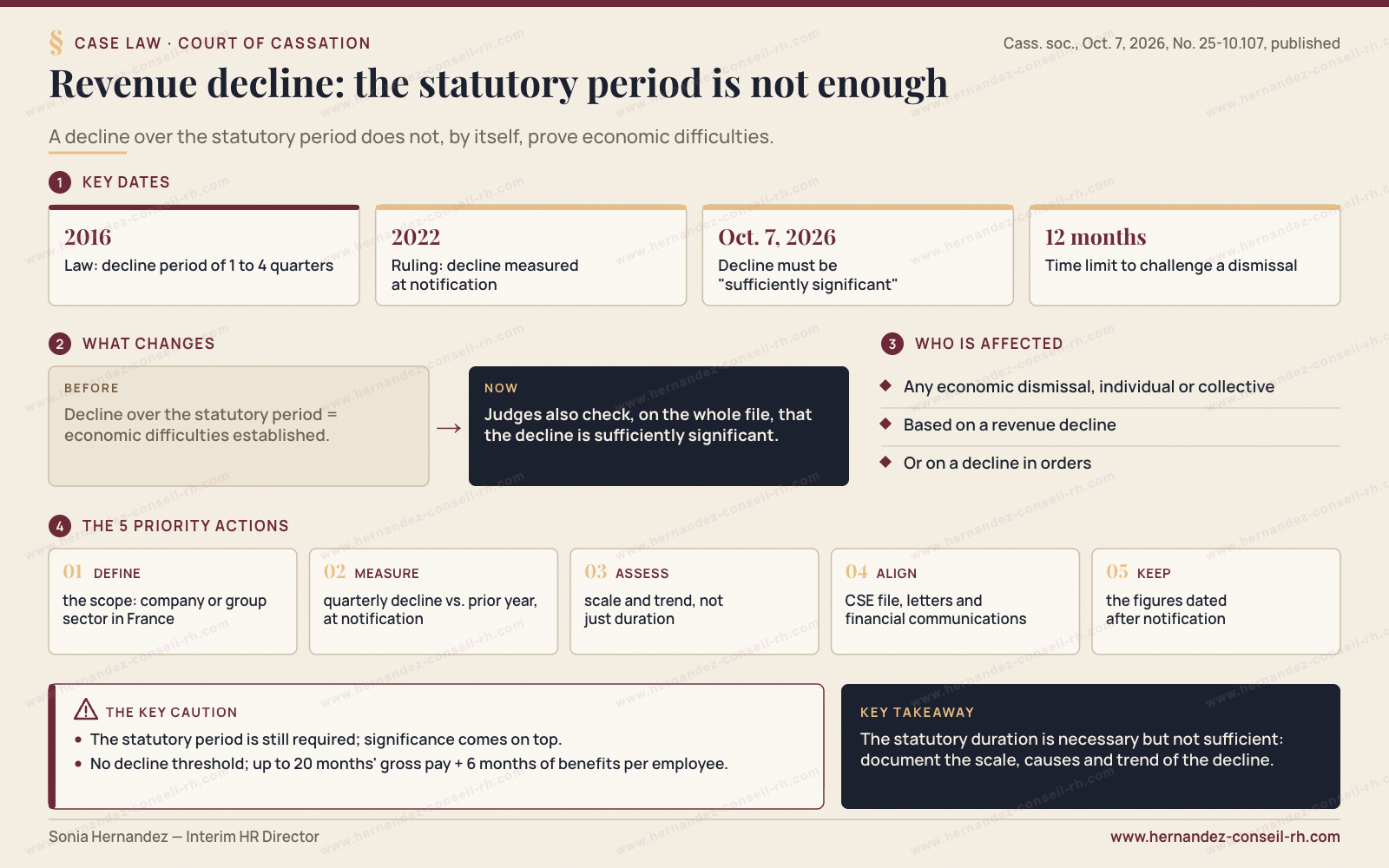
Since Law No. 2016-1088 of August 8, 2016, Article L. 1233-3 of the French Labor Code defines when a decline in orders or revenue is "significant": when it lasts, compared with the same period of the previous year, at least:
- one quarter in companies with fewer than 11 employees,
- two consecutive quarters with 11 to 49 employees,
- three consecutive quarters with 50 to 299 employees
- and four consecutive quarters with 300 or more.
The text lends itself to an arithmetic reading: once the duration is met, the economic ground is established.
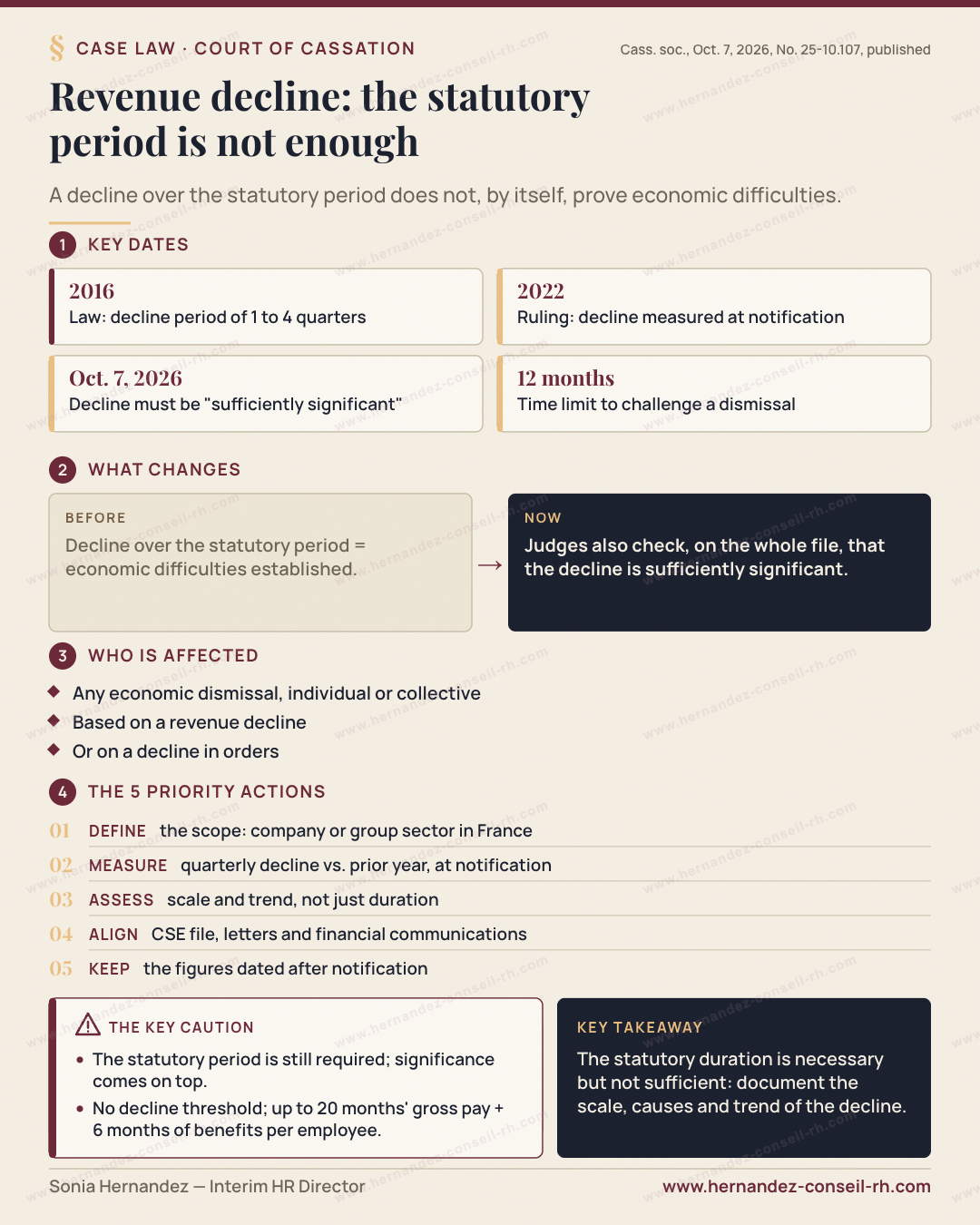
The Social Chamber of the Court of Cassation, France's highest court for civil and employment matters, rejected that reading. In a ruling of October 7, 2026 (No. 25-10.107, published), it held that the text, "read in light of the legislative history," requires judges to check, on the whole file, that the change in the indicator is "sufficiently significant" to establish economic difficulties that justify the dismissal. The statutory duration is necessary, but not sufficient.
The case involved an asset management company with about thirty employees. In June 2020 it started the economic dismissal of two analysts, who accepted the job-security contract (CSP), citing a revenue decline over the first two quarters of 2020 compared with 2019. The statutory duration was met. The court of appeal nonetheless found:
- a temporary drop caused by the pandemic, followed by a recovery,
- statements by management about an improvement
- and no figures after October 2020, although the employer conceded that financial markets recovered from November 2020.
It held the dismissals unjustified, and the Court of Cassation upheld that decision.
What is at stake
Legal
The labor court reviews the economic ground employee by employee, and any doubt benefits the employee (Article L. 1235-1 of the French Labor Code). Without real and serious cause, the employer:
- owes damages under the scale in Article L. 1235-3 of the French Labor Code, up to 20 months' gross pay,
- and repays France Travail up to six months of benefits per employee (Article L. 1235-4 of the French Labor Code, subject to the exceptions in Article L. 1235-5 of the French Labor Code).
In a layoff plan (PSE), neither the majority agreement (Articles L. 1233-24-1 and L. 1233-24-2 of the French Labor Code) nor the labor administration's validation or approval (Articles L. 1233-57-2 and L. 1233-57-3 of the French Labor Code) covers whether the economic ground is genuine.
Labor relations
In companies with at least 11 employees, the works council (CSE) is consulted on any collective dismissal and receives the economic reasons for the project with the notice of meeting:
- below ten dismissals (Articles L. 1233-8 and L. 1233-10 of the French Labor Code)
- and for ten or more dismissals (Articles L. 1233-29 or L. 1233-30 depending on headcount, and L. 1233-31 of the French Labor Code).
In companies with at least 50 employees, for ten or more dismissals over thirty days, it may appoint an expert paid by the employer, who can also assist the negotiating unions (Articles L. 1233-34 and L. 2315-80 of the French Labor Code). The analysis will focus on the scale, causes and outlook of the decline: a well-supported file shared early makes agreement easier; a weak one fuels litigation.
Financial
The risk multiplies with the number of employees concerned: it should be assessed, provisioned where appropriate and built into the overall cost of the project.
Reputation
Upbeat public statements can contradict the economic ground: in this case, management's statements were taken into account by the lower courts. If management announces a recovery, it is the project that needs revisiting, not the message.
Who is affected
- Any company, whatever its size, that bases a planned economic dismissal, individual or collective, on a decline in orders or revenue.
- Group subsidiaries: difficulties are assessed at the level of the business sector shared by the company and the group companies established in France, including those owned by a foreign parent, absent fraud (Article L. 1233-3 of the French Labor Code). Results abroad do not count; a decline limited to the subsidiary is not enough if the sector remains stable in France.
- Employee representatives, in companies with at least 50 employees: upstream, the works council may use its economic alert right, with the assistance of a certified accountant once per financial year (Articles L. 2312-63 and L. 2312-64 of the French Labor Code).
Individual mutual terminations and collective mutual terminations fall outside economic dismissal and are not affected (Article L. 1233-3, last paragraph of the French Labor Code).
What to do before starting an economic dismissal
- Use the right scope: the company alone or, within a group, the business sector shared by the group companies established in France.
- Measure the decline quarter by quarter at the notification date, against the same period of the previous year (Cass. soc., June 1, 2022, No. 20-19.957), and keep the figures updated until the letters are sent.
- Qualify scale and trend:
- amounts and percentages,
- margins,
- cash position,
- gross operating surplus (EBE, close to EBITDA),
- order book
- and forecasts.
- Explain the causes and anticipate what happens next: in this case, the recovery and the lack of figures after October 2020 weighed against the employer.
- Keep the figures consistent. The same data must underpin:
- the economic and social database (BDESE),
- the file given to the works council,
- dismissal letters
- and financial communications.
- Give employee representatives all relevant information with the notice of meeting, as the law requires, and answer their questions precisely.
- Keep post-notification data: claims can be brought for twelve months (Article L. 1235-7 of the French Labor Code; Article L. 1233-67 of the French Labor Code where the employee accepted the CSP, if the offer mentioned that time limit).
Project already under way?
- consultation in progress: complete the data before the works council gives its opinion,
- letter notified less than fifteen days ago: the employer may clarify the grounds (Articles L. 1235-2 and R. 1233-2-2 of the French Labor Code)
- and dismissals less than twelve months old: audit the file and assess the risk.
Points to watch
- Two cumulative tests. The statutory duration is still required; significance comes on top. A sharp but too brief decline still fails the first test.
- Other indicators remain available (operating losses, deteriorating cash or gross operating surplus, any other evidence), but their change must also be significant (Article L. 1233-3, 1° of the French Labor Code).
- The economic ground is not everything. The actual elimination of the job and the search for redeployment are still reviewed (Articles L. 1233-3 and L. 1233-4 of the French Labor Code).
- Scope over time. Phrased in general terms and published, the ruling reaches beyond the pandemic context and is expected to apply to pending cases.
In-depth analysis
Scope of the ruling: from a duration test to a review of scale
The ruling was handed down by a section-level panel of the Social Chamber (formation de section) and published in the Court's official reports (No. 803 FS-B). It rejects the appeals of both the employer and the employees and states a general rule: the duration set by Article L. 1233-3, 1° of the French Labor Code is a necessary condition, but judges must still check, on the whole file, that the change is "sufficiently significant."
The solution builds on case law developed since 2022:
- The relevant date. The duration of the decline is measured over the period around the notification of the dismissal, compared with the same period of the previous year; a decline over an earlier calendar year is not enough (Cass. soc., June 1, 2022, No. 20-19.957).
- Other indicators. If the revenue decline is not established over the statutory period, judges must look at the whole file to see whether another indicator establishes the difficulties (Cass. soc., Sept. 21, 2022, No. 20-18.511).
- Significance. Judges must check that the change in the indicator relied on is significant; that case concerned operating losses (Cass. soc., Oct. 18, 2023, No. 22-18.852, published).
The 2026 ruling applies this review to revenue itself, even though the wording of the statute seemed to make duration sufficient. That is its main contribution: the method is consistent, but it moves away from a purely arithmetic reading.
The legislative history
The Court reads the text "in light of the legislative history" of Law No. 2016-1088 of August 8, 2016. The original bill left the length of the decline to industry-wide agreements, with a minimum of two quarters and four quarters by default. The National Assembly's social affairs committee (rapporteur's amendment AS1050, in French) introduced the notion of a "significant change" in an indicator and the one-to-four-quarter scale based on headcount; its rapporteur considered it essential that judges keep some discretion. In the Senate, the committee noted that a significant decline was not defined in objective terms and proposed a presumption from a 30% decline; that threshold was not adopted. The statute therefore sets no percentage.
What the lower courts relied on
The court of appeal relied on:
- a drop in management fees from March 2020 (from €2.280 million in February to €1.538 million in May), followed by a recovery,
- the founder's statements about the funds' rebound after March 18, 2020
- and the lack of figures after October 2020 and of evidence on performance fees.
The employer had argued that revenue had been falling since 2017 and kept falling in the third quarter of 2020. The Court of Cassation upheld the finding that the difficulties were not sufficiently established, holding that the lower court's findings made the inquiries sought irrelevant, including into whether the recovery was foreseeable.
What practitioners say
- Judicial discretion confirmed (Frédéric Chhum and Léa Fakhreddine, Village de la Justice, Nov. 5, 2026). The statutory thresholds remain, but judges keep control. A temporary decline followed by a recovery does not automatically make every dismissal unjustified: it all depends on the file.
- No numerical threshold (Bruno Louvel, Oct. 17, 2026). No percentage tells employers in advance whether a decline will be deemed sufficient. The file must cover every component of the indicator; here, performance fees were not documented.
- No presumption (Adeline Heredia, Oct. 16, 2026). The statutory duration is not a conclusive presumption. Employers should combine several indicators and check the group scope. Accepting the CSP does not prevent a challenge.
- Counter-indicators (Aurélie Arnaud, 2A Avocat). A decline of a few points in a profitable company with solid cash may not be enough. Employers should anticipate the arguments employees may raise: dividends, profits, new hires.
- The works council experts' view (Grégory Gamot, CE Expertises, Oct. 28, 2026). Judges also weigh management's public statements and the figures the employer does not produce. The employer's answers, once recorded in the minutes, can also help employees who later challenge their dismissal.
- A temporary crisis (Xavier Berjot, Sancy Avocats, Oct. 12, 2026). A crisis followed by a recovery can make a dismissal unjustified.
At the time of writing, the leading French law journals had not yet published commentary we could access. The reporting judge's report (Mr. Carillon) and the Advocate General's opinion (Ms. Grivel), cited in the ruling, could not be consulted.
Open questions
- The threshold. How large must a decline be to count as "sufficiently significant"? Neither the statute nor the ruling says.
- Recovery. Should judges assess, as of the dismissal date, whether a recovery was foreseeable? Here the Court upheld the court of appeal without requiring that inquiry.
- Groups. How does this review fit with assessing difficulties across the business sector shared by the group companies established in France?
- Counter-indicators. How much weight should profits, dividends or new hires carry?
- Reach. The ruling expressly covers both revenue and orders; phrased in general terms, it appears to cover any temporary decline.
The financial exposure
- Damages (Article L. 1235-3 of the French Labor Code). In a company with at least 11 employees, the scale provides for:
- 3 to 3.5 months' gross pay for two years of service,
- 3 to 10 months for ten years
- and up to 20 months from 29 years of service.
- Repayment to France Travail (Article L. 1235-4 of the French Labor Code). Judges order repayment of the benefits paid, up to six months per employee. This does not apply (Article L. 1235-5 of the French Labor Code):
- to employees with less than two years of service
- or in companies with fewer than 11 employees.
- Where the employee accepted the CSP. Without an economic ground, the employer also owes pay in lieu of notice and the related paid leave, less any amounts already paid on that basis (Cass. soc., May 10, 2016, No. 14-27.953, published).
- An order of magnitude. For an employee with two years of service in a company with at least 11 employees:
- 3 to 3.5 months' pay,
- notice pay (where the CSP was accepted)
- and up to six months of benefits to repay.
How employee representatives will read it
The ruling gives the works council a set of questions for any consultation based on a revenue decline:
- the scale of the decline quarter by quarter, its causes and the latest available figures;
- changes in cash, gross operating surplus, operating income and the order book;
- within a group, sector data for the group companies established in France.
In companies with 50 or more employees planning at least ten dismissals over 30 days, the expert appointed by the works council (Article L. 1233-34 of the French Labor Code) and the economic alert right (Article L. 2312-63 of the French Labor Code) help substantiate these questions, and answers recorded in the minutes can later serve the employees. For employers, the best defense is a complete economic file, consistent with financial communications and updated until notification.
Cross perspectives
The CFO's view
The figures behind the economic ground come from the accounts. The CFO makes sure that the economic memo, the economic and social database (BDESE), where applicable, and financial communications rest on the same data, updated until notification, and that they show the scale and trend of the decline, not just its duration.
The works council accountant's view
Appointed by the works council when at least ten dismissals over 30 days are planned in a company with 50 or more employees (Article L. 1233-34 of the French Labor Code), the accountant compares the decline cited with previous years and the outlook, and asks for the latest figures. A file that shows only the duration of the decline is open to challenge: the ruling makes clear that judges look at all the evidence.
Sonia Hernandez, Interim HR Director — November 6, 2026
General information current as of November 6, 2026; it does not constitute legal advice.