Contents
The issue
Directive (EU) 2023/970 aims to make pay gaps between women and men visible, and therefore fixable. Among other things, it requires employers to:
- tell candidates the starting pay or its range, and stop asking about their pay history (Article 5 of the Directive),
- make the criteria for setting pay and pay progression accessible to employees (Article 6),
- answer within two months any employee who asks for their own pay and the average pay levels, by sex, in their category (Article 7),
- report pay gap indicators, from 100 employees (Article 9)
- and run a joint pay assessment with employee representatives when a gap of at least 5% in a category is neither justified by objective criteria nor corrected within six months (Article 10).
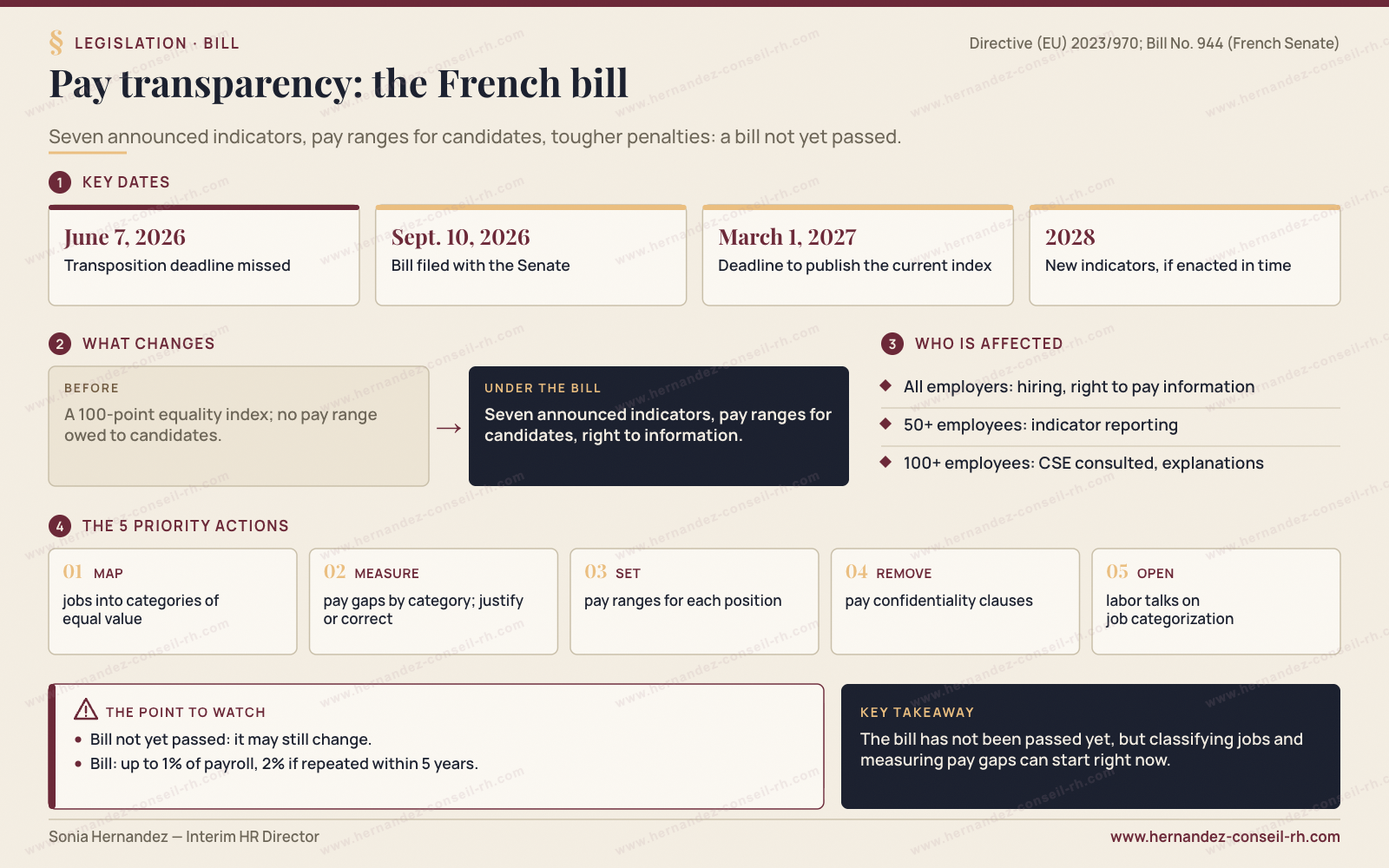
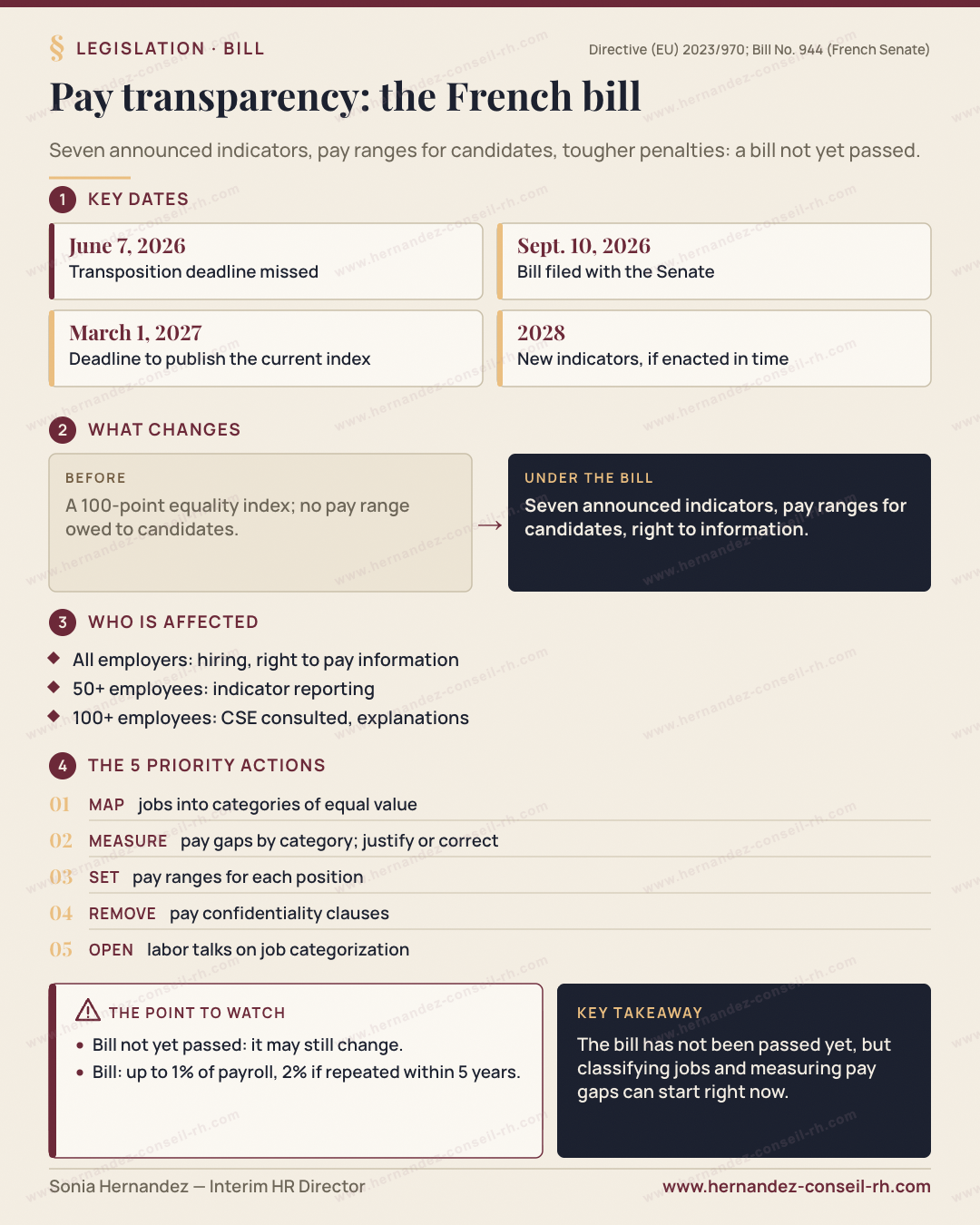
The transposition deadline was June 7, 2026 (Article 34). France missed it. Bill No. 944 (2025-2026) was presented to the Council of Ministers on September 10, 2026 and filed with the Senate the same day under the fast-track procedure. As of November 9, 2026, it is at first reading, with no debate scheduled.
In principle, an untransposed directive does not create direct obligations for private employers. French courts, however, interpret existing French law in light of the Directive, in particular the "equal pay for equal work" principle in Article L. 3221-2 of the French Labor Code, as far as the French wording allows. The principle of equal pay for women and men in Article 157 of the Treaty on the Functioning of the European Union also applies directly between employers and employees.
What the bill changes
A new, more demanding index
The gender equality index (Article L. 1142-8 of the French Labor Code as currently worded) would be replaced by pay gap indicators set by decree (seven, according to the explanatory memorandum), reported from 50 employees (Article 1 of the bill, in French). The government says six of them will be precalculated from the monthly payroll filing (DSN). The seventh, the gap by category of equal work or work of equal value, is the most demanding: it requires jobs to be categorized first.
From 50 to 99 employees, the works council (CSE) would be informed of the indicators. If a gap in a category exceeds the threshold set by decree without objective justification, the employer would have to negotiate on gender equality at work or, failing an agreement, adopt an action plan. A collective agreement could exempt the employer from reporting the seventh indicator (future Articles L. 1142-8-1 to L. 1142-8-3 of the French Labor Code).
From 100 employees, the works council would be consulted on the indicators. Where a gap exceeds the threshold set by decree, no more than 5% according to the government, the employer would have to:
- justify it with objective, gender-neutral criteria, after consulting the works council,
- failing that, correct it through a collective agreement or an action plan,
- report the indicator again within six months
- and, if the gap persists, negotiate and carry out a joint pay assessment with employee representatives.
Employers could also start the joint pay assessment directly, and the labor administration could order them to do so (future Articles L. 1142-8-6 to L. 1142-8-11 of the French Labor Code). In these companies with 100 or more employees, employees, the works council and union delegates could also ask for reasoned explanations of the latest reported indicators; if the request concerns the gap by category, even below the threshold, the employer would have to justify it on objective grounds or, failing that, correct it by unilateral decision (future Article L. 1142-8-5 of the French Labor Code).
Hiring rules
Under the bill (Articles 3 and 4, in French):
- candidates receive an initial pay range and the relevant collective agreement provisions, in writing before or during the interview if there is no job posting (future Article L. 1221-9-1 of the French Labor Code),
- every published job posting states this information (future Article L. 5332-2-1 of the French Labor Code),
- employers can no longer ask about a candidate's current or past pay (Article L. 1221-6 of the French Labor Code, as amended)
- and any contract clause barring employees from disclosing their pay is prohibited (future Article L. 1221-5-2 of the French Labor Code).
Employees' right to information
Every employee could ask for their pay level and the average pay levels, by sex, in their category. Employers must remind employees of this right every year and answer within two months (future Article L. 1142-7 of the French Labor Code). The criteria used to set pay and pay progression would also have to be made available to employees (Article L. 3221-6 of the French Labor Code, as amended).
"Equal value" clarified
Article L. 3221-4 of the French Labor Code would be rewritten to include soft skills and working conditions. Job categories would be set by company agreement or, if negotiations fail, by a unilateral decision of the employer, taken after consulting the works council and valid for three years (future Article L. 3221-4-1 of the French Labor Code). Industry-level bargaining on a categorization method would have to open within six months of enactment; company agreements or unilateral decisions could adopt it (Article 6 of the bill).
Tougher penalties
- a penalty capped at 1% of payroll, raised to 2% for a new breach within five years (future Article L. 1142-10-1 of the French Labor Code),
- up to €450 per breach of the information duties, an amount that can be doubled for a repeat breach within five years (future Article L. 1142-10-5 of the French Labor Code),
- two years' imprisonment and a €7,500 fine where sex discrimination (hiring, pay, career) affects several people, compared with one year and €3,750 today (Article L. 1146-1 of the French Labor Code, as amended)
- and the option for public buyers to exclude from public contracts a company with 100 or more employees penalized for certain breaches.
In litigation, Article L. 3221-8 of the French Labor Code would be rewritten. If an employee or candidate shows that the employer breached certain pay transparency duties (right to information, indicators and gap correction, information for candidates, access to pay criteria), they would no longer need to present facts suggesting discrimination: the employer would have to prove that its decision rests on objective factors unrelated to discrimination, unless it shows that the breach was minor and clearly unintentional. Comparisons could also involve employees of another employer whose pay is set by the same group-wide or multi-employer collective agreement (future Article L. 3221-8-1 of the French Labor Code).
Who is affected
- All companies, whatever their size: hiring, an end to pay confidentiality clauses and employees' right to information.
- From 50 employees: reporting of indicators. This goes beyond the Directive, which makes reporting mandatory only from 100 employees: the bill keeps the threshold of the current index.
- From 50 to 99 employees: works council information, and negotiation or an action plan for an unjustified gap above the threshold.
- From 100 employees: works council consultation, requests for explanations, the correction procedure and a joint pay assessment if the gap persists.
- Employee representatives, informed or consulted on the indicators depending on headcount, involved in the joint assessment and party to the negotiation on job categories.
The timeline
According to the Council of Ministers statement (in French), the current index is kept for the 2027 filing and the new regime is announced for 2028; this timeline assumes the law is enacted in 2027. If it is not passed in time, the index remains due. The bill provides for entry into force by decree, no later than one year after enactment (Article 21 of the bill), then a timeline based on headcount for the seventh indicator:
- 250 employees or more: every year, no later than one year after enactment,
- 150 to 249 employees: every three years, no later than one year after enactment,
- 100 to 149 employees: every three years, no later than three years after enactment
- and 50 to 99 employees: every three years, no later than six years after enactment.
The other measures are not deferred: hiring rules, the ban on pay confidentiality clauses, criminal penalties and the burden-of-proof rules would apply the day after the law is published; the €450 administrative fine that sanctions some of these rules would, however, apply only once Article 1 takes effect, no later than one year after enactment. Employees' right to information would apply once job categories are in place, and no later than the date set by decree.
What to do now
- Publish and file the 2027 index under the current rules; it must be published by March 1 (Article D. 1142-4 of the French Labor Code).
- Map jobs and prepare categories of "work of equal value" based on objective criteria:
- skills,
- effort,
- responsibilities
- and working conditions.
- Measure gaps by category and document an objective justification for each gap.
- Review hiring:
- salary ranges for each position,
- interview guides with no questions on past pay
- and job postings.
- Document and share the criteria used to set and raise pay.
- Remove any pay confidentiality clause from employment contract templates.
- Open talks with unions on job categories, as part of the negotiation on gender equality at work (Article L. 2242-1 of the French Labor Code).
- Make payroll data reliable, broken down by sex and category, since the indicators will rely on it.
Watch points
- A bill still under debate. Parliament may amend it; the articles cited here are not yet in force.
- The gap threshold, no more than 5% according to the government, would be set by decree, as would the exact list of indicators.
- Current law still applies: with an index below 75 points for three years, the penalty can reach 1% of payroll (Article L. 1142-10 of the French Labor Code); the same applies without an agreement or action plan on gender equality, or without publication of the index (Article L. 2242-8 of the French Labor Code).
- Sensitive data. Category gaps sometimes involve very few people: the bill then limits disclosure to works council members, who are bound by confidentiality, and an employee whose request would identify a colleague receives no answer (future Article L. 1142-7-1 of the French Labor Code).
In-depth analysis
Scope: a late transposition that goes beyond the minimum
Bill No. 944 followed consultations with the social partners on a draft sent on March 6, 2026, then on a revised version on June 4, 2026. The Conseil d'État, France's highest administrative court, which also advises the government, gave its opinion on July 23, 2026: it considers it unlikely that France will meet the first EU reporting deadline of June 7, 2027 for companies with 150 or more employees.
On several points, the bill goes beyond the minimum required by the Directive:
- reporting of indicators from 50 employees, while the Directive makes it mandatory from 100,
- a salary range in every published job posting, where the Directive leaves the channel open (job posting, before the interview or otherwise): the Conseil d'État notes that this duty is not a transposition measure
- and a financial penalty proportional to payroll, inherited from the current index.
It keeps the logic of the current index, which eases the transition: a reporting system with a duty to correct and dialogue with the works council.
Current law still fully applies
Until the law is passed, employers remain bound by:
- the principle of equal pay for the same work or work of equal value (Articles L. 3221-2 and L. 3221-4 of the French Labor Code),
- the gender equality index and its annual publication (Article L. 1142-8 of the French Labor Code),
- mandatory negotiation on gender equality at work (Articles L. 2242-1 and L. 2242-17 of the French Labor Code)
- and the equality indicators in the economic, social and environmental database (BDESE) (Article L. 2312-18 of the French Labor Code).
What practitioners say
- Prepare without waiting (Deloitte Société d'Avocats, Sept. 30, 2026, in French). The bill is not in force, and its passage before the presidential election looks doubtful, as the National Assembly's session may end as early as February 2027. The authors still advise starting the heavy work now: job classifications, hiring, confidentiality clauses and the data needed to calculate the future indicators.
- Ten changes (Capstan Avocats, June 8, 2026, in French). The firm presents the ten main changes in the June 4 version of the draft, including the indicator by category and the salary range owed to candidates.
- Document the gaps (EY Société d'Avocats, March 16, 2026, in French). Categorizing jobs of equal value is the keystone of the system; the main penalty risk lies in failures to report, consult and file.
- What the draft changes (Frédéric Chhum and Victoire Benazet, Village de la Justice, updated June 29, 2026, in French). The authors detail the changes in the draft bill: salary range and collective agreement provisions, no more questions on past pay, job categories and justification of gaps.
Open questions
- The parliamentary timetable. Will the bill pass before the 2027 deadline? No debate had been scheduled as of November 9, 2026.
- The decrees. The exact list of indicators, their calculation and the gap threshold, no more than 5% according to the government, depend on decrees that have yet to be issued.
- Job categories. How can categories of "equal value" be built without simply copying the industry-wide classification? Will the labor administration review the criteria?
- Small categories. How can confidentiality be protected when a category includes very few women or men, without depriving employees of their right to information?
- Groups. Indicators are still calculated company by company: how can a group-wide pay policy fit with categories defined entity by entity?
Financial exposure
- Today. A penalty of up to 1% of payroll if the index stays below 75 points after three years (Article L. 1142-10 of the French Labor Code) or without an agreement or action plan on gender equality, or without publication of the index (Article L. 2242-8 of the French Labor Code); the two penalties do not add up.
- Tomorrow, under the bill:
- up to 1% of payroll, and 2% for a new breach within five years,
- up to €450 per breach of the information duties, for example for each unanswered employee request or each candidate not informed, which can be doubled for a repeat breach within five years
- and two years' imprisonment and a €7,500 fine for sex discrimination affecting several people.
- An order of magnitude. For a payroll of €10 million, the penalty can reach €100,000, and €200,000 for a repeat breach, on top of back pay in individual litigation.
The employee representatives' perspective
For the works council and unions, the bill opens three avenues:
- negotiating the job categories on which the whole system rests,
- access to indicators by category, more detailed than the current index
- and the joint pay assessment, which requires the employer to explain and correct unjustified gaps.
For employers, the best response is to open negotiations on job categories early, based on objective and documented criteria: a negotiated agreement secures the system better than a unilateral decision, which is limited to three years.
Cross perspectives
The Comp & Ben view
The first task is the pay architecture. Without jobs mapped to categories and a pay range for each position, it is impossible to inform candidates or answer an employee within the two months set by the directive and the bill. Comp & Ben therefore reconciles the industry-wide classification, job titles and actual pay, then documents for each gap its objective, gender-neutral criterion.
The CFO's view
The CFO costs two items: correcting unjustified gaps, to be built into the pay-raise budget, and the penalty risk: up to 1% of payroll, 2% for a repeat breach under the bill, and up to €450 per unanswered request. The CFO also makes sure that the payroll data reported match the figures the company publishes elsewhere.
The data protection officer's view
The indicators and the right to information involve individual pay, sometimes in very small categories. The data protection officer makes sure access to detailed payroll data is restricted and the confidentiality rules in the bill are applied before answering any request.
Sonia Hernandez, Interim HR Director — November 9, 2026
General information current as of November 9, 2026, based on the bill filed with the French Senate; it does not constitute legal advice.