Contents
The issue
A managerial optician, hired in 2001 and dismissed for serious misconduct in June 2020, sought damages for the absence of career reviews and periodic medical checkups. The Amiens Court of Appeal dismissed both claims because she neither described nor documented any harm.
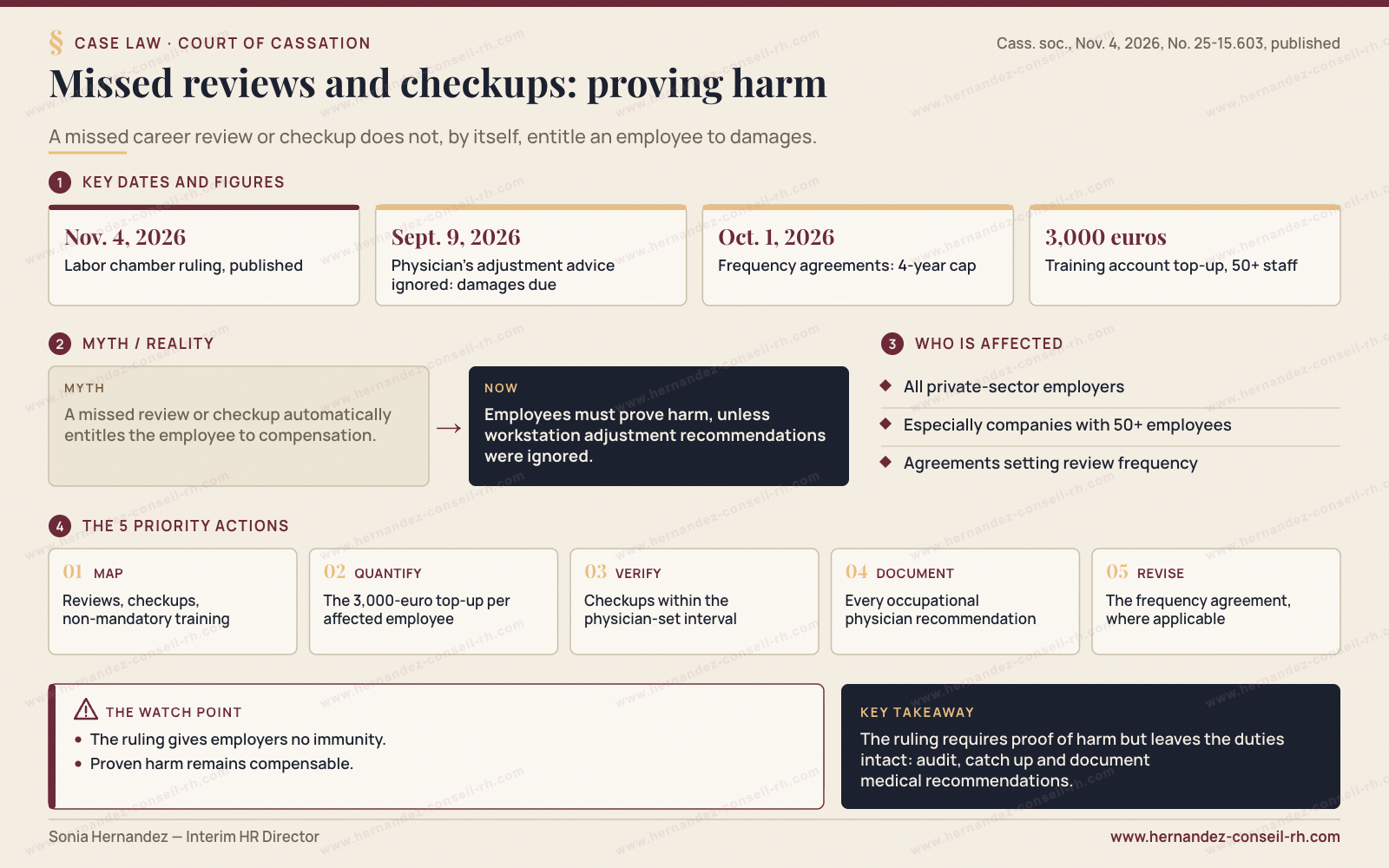
In a ruling of November 4, 2026 (No. 25-15.603, F-B) (in French), the labor chamber of the Court of Cassation, France's highest court for civil and employment matters, upheld the rejection of both claims:
- failing to hold the review required by Article L. 6315-1 of the French Labor Code (in French) does not, by itself, give rise to compensation: the employee must prove the resulting harm,
- the absence of the periodic checkup required by Article R. 4624-16 of the French Labor Code (in French) does not inevitably harm health, because Article 14 of Directive 89/391 grants no clear, precise and unconditional individual right to medical monitoring
- and in both cases, whether harm exists is for the trial judges to decide.
The Court did, however, overturn the voiding of the dismissal: the court of appeal could not order it without establishing that the employee was dismissed for having suffered or refused workplace harassment. The award of damages for workplace harassment, which the appeal did not challenge, stands. The employer did not win on every point. The Court also overturned, in the employee's favor, the refusal to order corrected pay slips and the cap placed on her overtime back pay. The case now goes to the Douai Court of Appeal.
What is at stake
Legal
The ruling confirms the line drawn in 2016: no automatic damages, except in targeted cases. That line keeps moving, however. On September 9, 2026, the full labor chamber held that ignoring an occupational physician's recommendations for individual workstation adjustments entitles the employee to damages without further proof. Skipping a checkup may cost nothing in damages; disregarding what the physician prescribed will.
Labor relations
For members of the works council (CSE), reviews and checkups remain concrete markers of the employer's approach to careers and health. A large backlog fuels distrust and requests for expert assessments, even without individual lawsuits.
Financial
The main exposure is not damages. In companies with 50 or more employees, Article L. 6323-13 of the French Labor Code (in French) requires a top-up of the personal training account (CPF) when, over eight years, an employee has not had the required reviews and at least one non-mandatory training; Article R. 6323-3 of the French Labor Code (in French) sets it at 3,000 euros.
Reputation
Letting reviews slide sends a poor signal on employer brand and employability, just as the law tightens the link between career paths and occupational health.
Who is affected
All private-sector employers must organize reviews and health monitoring. The most exposed are:
- companies with 50 or more employees, the only ones subject to the corrective CPF top-up,
- multi-site networks where checkups are scheduled locally,
- companies whose collective agreement sets its own review schedule, since the new wording has applied to such agreements since October 1, 2026
- and employers facing termination disputes, where these claims are often added to others.
As worded under Law No. 2025-989 of October 24, 2025, Article L. 6315-1 of the French Labor Code (in French) provides for a career path review within the first year after hiring, then every four years, with a full retrospective every eight years. The facts date from 2020 and the employee's argument targeted the wording in force until October 26, 2025 (a review every two years, a retrospective every six), but the principle stated in paragraph 5 of the ruling makes no reference to frequency.
What to do
- map, for each employee, the dates of the last review and retrospective and any non-mandatory training,
- quantify exposure to the 3,000-euro top-up in companies with 50 or more employees and catch up before each retrospective falls due,
- check with the occupational health service that every employee has had a checkup within the interval set by the occupational physician, five years at most for the standard information and prevention visit,
- document how each individual recommendation from the occupational physician is implemented and, if it is declined, give written reasons,
- verify that pay slips show the correct job title and collective agreement classification
- and, where applicable, revise the collective agreement on review frequency.
Watch points
The ruling grants no immunity. It simply leaves the burden of proving harm on the employee: an employee who shows a lost chance of advancement, or a deterioration in health linked to missing monitoring, can still recover damages, subject to the trial judges' assessment.
Health deserves particular care. Under Article L. 4624-6 of the French Labor Code (in French), the employer must take the occupational physician's proposals into account and give written reasons for any refusal. Where those proposals concern individual measures to adjust, adapt or transform the workstation, failing to follow them, not the missing checkup, now entitles the employee to damages on its own, according to the full chamber.
Two further reversals highlight underestimated risks:
- an employee may demand corrected pay slips when the job title or classification is wrong, and the time elapsed since termination is no ground for refusal, under Article R. 3243-1 of the French Labor Code (in French)
- and, after termination, a back pay claim may cover the three years preceding it, under Article L. 3245-1 of the French Labor Code (in French).
In-depth analysis
Scope of the ruling
The ruling was issued by a three-judge panel (F) and published in the Bulletin (B). The two dismissals of the employee's arguments cite no provisions; the reversals rest on Articles L. 1152-2, as worded by the Law of August 6, 2012, and L. 1152-3 of the French Labor Code, Article R. 3243-1 of the French Labor Code, Article 954 of the French Code of Civil Procedure and Articles L. 3242-1 and L. 3245-1 of the French Labor Code. Article L. 1152-2 of the French Labor Code (in French) was rewritten by the Law of March 21, 2022, leaving Article L. 1152-3 of the French Labor Code (in French) unchanged.
The decision fits an established line of cases:
- on April 13, 2016 (No. 14-28.293, published) (in French), the labor chamber held that the existence and extent of harm are for the trial judges, in a case on late delivery of documents,
- on June 27, 2018 (No. 17-15.438, unpublished) (in French), it applied that rule to a missing pre-hiring medical exam,
- on September 4, 2024 (No. 23-15.944) (in French) and the same day (No. 22-16.129) (in French), it awarded damages on mere proof of a missed daily break, work during sick leave or work during maternity leave
- and on September 9, 2026 (No. 25-11.901, FP-B+R) (in French), the full chamber abandoned its December 9, 2020 position (No. 19-13.470) (in French) for individual occupational physician recommendations.
For the periodic checkup, the November 4 ruling uses the same wording as the Court of Justice of the European Union in Artemis Security (June 20, 2024, C-367/23), a case on medical monitoring of night workers recalled by the full chamber on September 9, 2026: a missing medical exam does not inevitably harm health, so proof of harm is still required.
What practitioners say
Open Lefebvre Dalloz, "Une semaine de jurisprudence sociale à la Cour de cassation," November 9, 2026. This weekly roundup (in French) files the ruling under two headings: contract performance for the review and the voided dismissal, and health and safety for the checkup.
Voltaire Avocats, news item, November 4, 2026. The firm (in French) sees continuity with the 2016 case law, despite exceptions on working time and rest. It stresses that harassment, even ongoing at termination, does not by itself void a dismissal.
Open Lefebvre Dalloz, overview, September 3, 2026. This summary table (in French) sorts employer breaches by whether they trigger automatic damages. Exceptions rest either on an express statute or on European rules protecting rights, notably on working time.
CFDT (French Democratic Confederation of Labor), September 14, 2026. The union confederation (in French) presents the September 9 ruling as a notable exception that eases the employee's burden of proof when individual recommendations are ignored.
Frédéric Chhum, attorney, September 29, 2026. His commentary (in French) approves the reversal and describes the "necessary harm" debate as an ongoing saga.
The main French law reviews were not freely accessible.
Open questions
- whether the rule extends to the career path review created by the Law of October 24, 2025, which seems likely since the reasoning does not depend on frequency, though not yet decided,
- what evidence will suffice to prove harm, such as a refused training request, a frozen classification or a lost chance of mobility,
- the weight of the finding, adopted by the court of appeal from the first-instance judges according to the employee's argument, that she herself scheduled the store's checkups, which the Court did not address
- and whether a prolonged lack of checkups could fall under the employer's safety obligation when it deprived the employee of any medical recommendation.
The court on remand must also determine whether the employee was dismissed for having suffered or refused harassment, not merely in a context of harassment.
Quantifying the risk
Three items of a different nature must be kept apart:
- the 3,000-euro CPF top-up per affected employee in companies with 50 or more employees, increased by 100% and paid to the Treasury if the employer fails to comply after formal notice,
- damages, now contingent on proof of harm
- and termination or pay awards, which often weigh more.
Illustrative case. A 120-employee company finds that 25 employees had neither a review nor non-mandatory training over the reference period. Exposure is 75,000 euros in top-ups, rising to 150,000 euros paid to the Treasury if the company does not comply after formal notice. By comparison, the overturned appellate ruling had awarded 34,900 euros for a void dismissal and capped overtime back pay at 11,535.51 euros.
The employee representatives' perspective
Employee representatives have several levers:
- requesting, at a works council meeting, a status report on reviews and CPF top-ups paid,
- questioning the employer on how occupational physician recommendations are implemented
- and calling for collective bargaining on review frequency, which the Law of October 24, 2025 requires companies to begin in order to revise existing agreements.
The employer's best response: a reliable dashboard, a dated catch-up schedule and a written procedure for following up on medical recommendations.
Cross perspectives
The CFO's view
The liability to provision is not primarily litigation. The 3,000-euro top-up is mechanical and subject to government audit. It is calculated employee by employee.
The occupational physician's view
Under Article R. 4624-16 of the French Labor Code (in French), the occupational physician sets the interval between checkups, five years at most. Under Article L. 6315-1 of the French Labor Code (in French), the career path review is held within two months of the mid-career medical exam, with no employer access to health data.
The employee-side attorney's view
An "automatic" damages claim is not viable on these two grounds. The file must document the harm: refused training, a frozen classification, unanswered health alerts and ignored medical recommendations.
Sonia Hernandez, Interim HR Director — November 9, 2026
General information current as of November 9, 2026; it does not constitute legal advice.