Contents
The issue
Article L. 2414-1 of the French Labor Code requires the labor inspector's approval to transfer a protected employee who is "included in a partial transfer of a business or establishment" under Article L. 1224-1 of the French Labor Code. The list includes:
- union delegates and former delegates,
- works council (CSE) members and former members,
- works council election candidates,
- union representatives on the works council,
- local representatives,
- members of the European Works Council and of special negotiating bodies
- and employees with a negotiating mandate.
In practice, many intragroup moves rely on a three-party agreement: the employee, the current employer and the receiving company jointly organize the change of employer. With the employee's consent, approval seemed unnecessary, and the court of appeal had ruled exactly that.
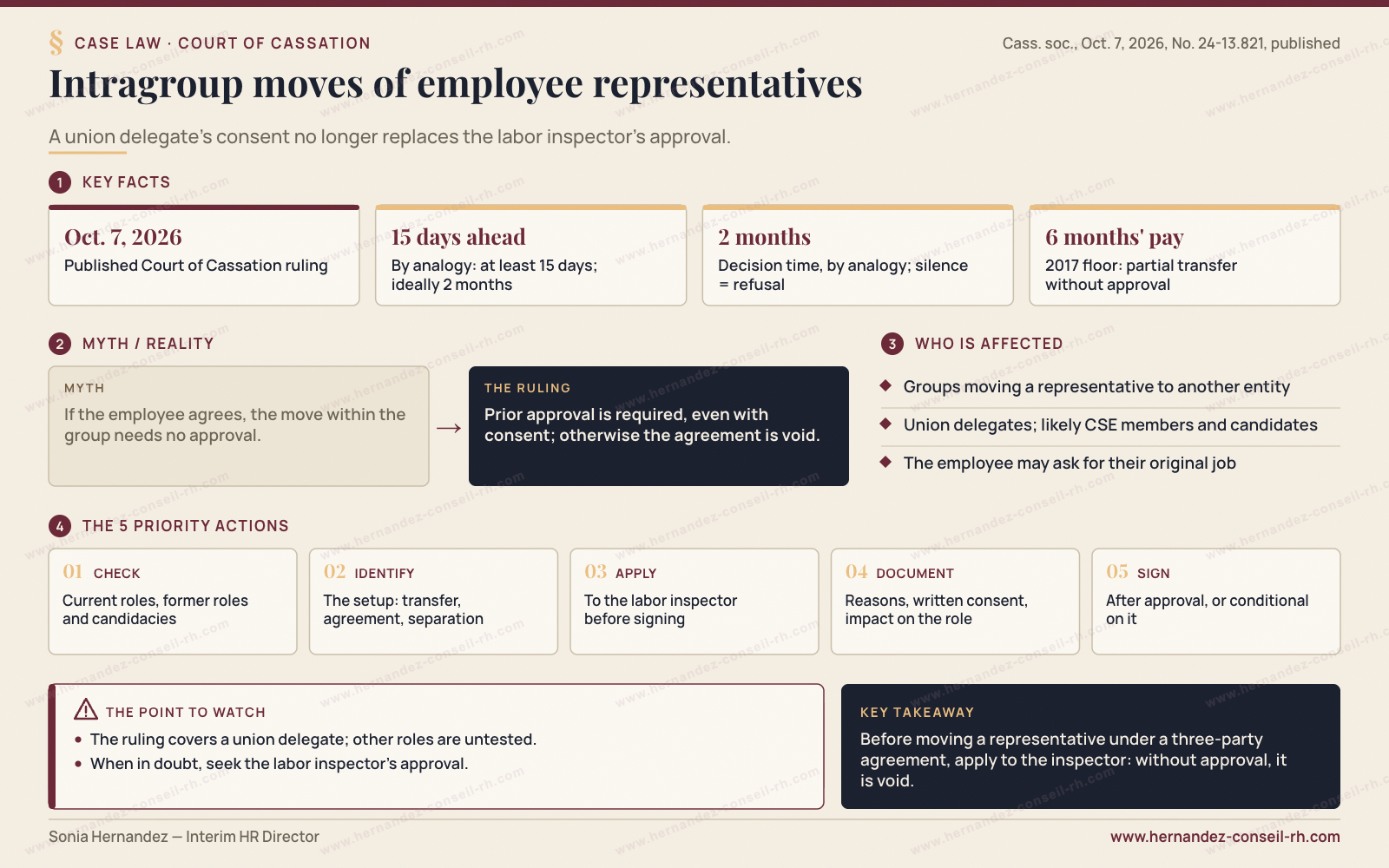
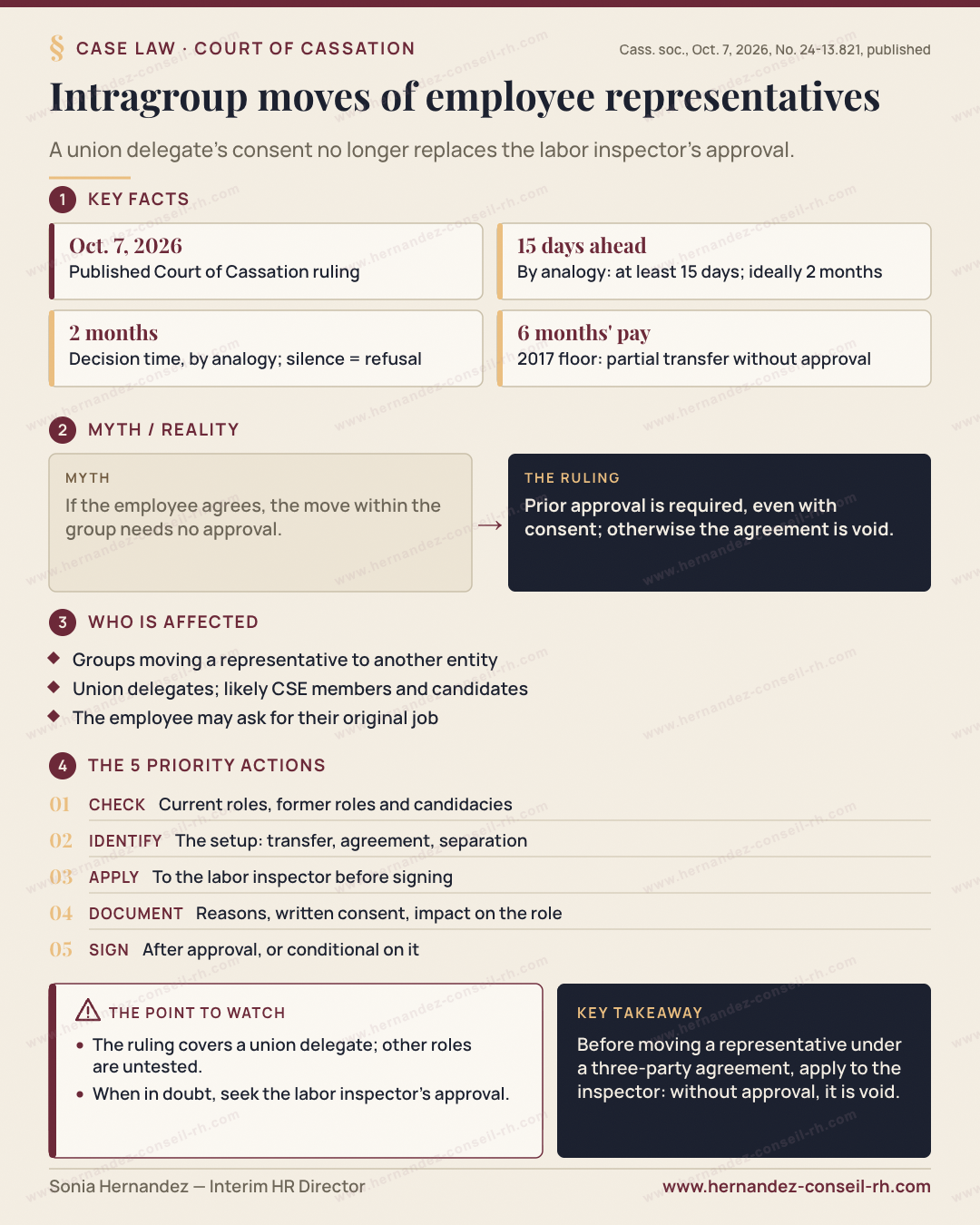
The Social Chamber of the Court of Cassation, France's highest court for civil and employment matters, reversed. In a ruling of October 7, 2026 (No. 24-13.821, published), it held that Article L. 2414-1 of the French Labor Code sets out a "general principle" that also applies when an employee is transferred "under a three-party agreement." Without approval, the agreement is void and the employee may ask to keep their job on the same terms and pay.
The case involved a coach driver and union delegate who joined another group company as a supervisor under a three-party agreement signed in February 2019, then was dismissed for serious misconduct by the receiving company about six months later. He sought reinstatement with his original employer and damages for breach of his protected status. The Versailles Court of Appeal, with a different panel, will now rule on those claims.
What is at stake
Legal
Three legal risks add up:
- voidness that spreads: a void agreement undermines everything that follows, and the reversal extends to the claims against the receiving company, including those on the later dismissal,
- criminal exposure: moving a union delegate, an elected works council member or a union representative on the works council "included in a partial transfer" without approval is punishable by one year's imprisonment and a €3,750 fine (Articles L. 2431-1 and L. 2432-1 of the French Labor Code); since criminal statutes are strictly construed, whether this extends to a three-party agreement is uncertain,
- and obstruction or union discrimination: depending on the facts, a move designed to sideline a representative could amount to either (Articles L. 2146-1 and L. 2146-2 of the French Labor Code).
Labor relations
By leaving the company in which they were appointed (Article L. 2143-3 of the French Labor Code), a union delegate also leaves the scope of their mandate: this is what the inspector's review protects. By analogy with the partial-transfer procedure, the labor inspector:
- checks that the move is not discriminatory (Article L. 2421-9 of the French Labor Code),
- hears the employee, who may be assisted by a union representative (Article R. 2421-17 of the French Labor Code)
- and decides within two months, silence meaning refusal (Articles R. 2421-11 and R. 2421-17 of the French Labor Code).
Financial
The cost of the move can grow with:
- keeping the employee in their original job,
- back pay
- and possible damages.
In a spin-off, a partial divestiture or a layoff plan (PSE) that includes redeployment within the group, the application for approval becomes a step in the project timeline, just like the works council consultation.
Reputation
A move perceived as sidelining an employee representative can weigh on labor relations for a long time.
Who is affected
- Groups that move staff between entities, spin off or combine activities or carry out partial divestitures.
- Employees who hold one of the roles or protections listed in Article L. 2414-1 of the French Labor Code. The ruling concerns a union delegate; its reasoning appears to extend to the other protections on the list, which future case law will have to confirm.
- The employee, who may ask to keep their original job; their union may also bring an administrative appeal against the inspector's decision (Article R. 2422-1 of the French Labor Code).
A transfer within the same company, with no change of employer, falls outside the ruling. A move to a group company established outside France has not been ruled on: seek approval as a precaution.
What to do before an intragroup move
- Check protections:
- current roles,
- former holders still protected, depending on the role,
- and election candidates.
- Identify the legal route:
- statutory partial transfer under Article L. 1224-1 of the French Labor Code,
- three-party agreement
- or termination followed by rehiring.
- Apply to the labor inspector before signing, at least 15 days before the planned transfer date and ideally two months before, with no effect before the decision, following the partial-transfer procedure by analogy (Article R. 2421-17 of the French Labor Code), and allow up to two months for a decision. How labor inspectorates will handle these applications remains to be seen; keep every decision, including any declining jurisdiction.
- Document the project:
- business reasons,
- no link with the representative role,
- the employee's written consent
- and what happens to the role.
- Sign only after approval, or make the move conditional on approval in the deal documents.
- Agreement already signed without approval:
- check the protection at the signing and effective dates,
- take no disciplinary action or dismissal at the receiving company without analysis
- and decide on next steps with counsel.
- Negotiate a framework: cover moves of employee representatives in the agreement provided for in Article L. 2141-5 of the French Labor Code, which reconciles personal life, working life and union or elected duties.
Points to watch
- Beyond union delegates. The ruling concerns a union delegate; for the other protections in Article L. 2414-1 of the French Labor Code, the issue has not been decided, and caution calls for seeking approval.
- Refusal. In a partial transfer, the employer must offer a similar job with equivalent pay in another establishment or part of the company (Article L. 2421-9 of the French Labor Code).
- Appeals. The employer, the employee or their union may appeal to the Minister of Labor within two months of notification; silence for four months means rejection (Article R. 2422-1 of the French Labor Code). A challenge before the administrative court is also possible within two months.
- Time limits (Article L. 1471-1 of the French Labor Code):
- two years for a claim on the performance of the contract
- and twelve months for a claim on its termination.
- Scope. The Court partially reversed and remanded: the principle is set, but the damages remain to be determined.
In-depth analysis
Scope of the ruling: an extension, not a reversal
The ruling was handed down by a section-level panel of the Social Chamber (formation de section) and published in the Court's official reports (No. 814 FS-B). The Court raised the point on its own motion and based its decision on Articles L. 1224-1 and L. 2414-1 of the Labor Code. Together, these signal a rule of principle rather than a case-specific decision.
The ruling reproduces, word for word, a 2002 formula: the approval required for a protected employee included in a partial transfer sets out a "general principle" that also applies to a transfer under a collective agreement after the loss of a contract; failing approval, the employee may ask to keep their job (Cass. soc., Nov. 20, 2002, No. 00-44.498). A May 28, 2003 ruling (No. 01-40.512) confirmed it. The Social Chamber has also held that an unlawful transfer is void and, under Article L. 1235-3 of the French Labor Code as worded before the 2017 labor ordinances, entitles an employee who does not seek reinstatement to damages of at least six months' pay, payable by the transferor (Cass. soc., March 23, 2017, No. 15-24.005, published). The 2026 ruling goes one step further by applying this "general principle" to an individual move the employee had agreed to.
It sets aside the argument drawn from the nature of a three-party agreement. The court of appeal echoed a 2016 ruling holding that such an agreement organizes the continuation of the contract, not its termination, so that the rules on mutual termination do not apply (Cass. soc., June 8, 2016, No. 15-17.555, published). That reasoning still stands, but it no longer removes the need for administrative review.
The ruling also follows a consistent line: no change to the contract or working conditions can be imposed on a protected employee, and acceptance cannot be inferred from silence or from continuing to work (Cass. soc., Feb. 15, 2023, No. 21-20.572). In 2026, the Court adds that even express consent does not strip the employee of the protection attached to their role.
What the labor inspector reviews
The inspector checks:
- that the transfer is not discriminatory, meaning that it has no link with the employee's representative duties or union membership (Article L. 2421-9 of the French Labor Code; Conseil d'État, Oct. 12, 1990, No. 87204)
- and, in a partial transfer, whether the transaction is genuine and whether the contract was actually performed in the transferred unit.
The civil courts remain competent to sanction fraud (Cass. soc., Nov. 23, 2022, No. 21-11.776). Until approval is granted, the transferor remains the employee's employer (Conseil d'État, June 24, 2013, No. 340128).
What practitioners say
- A critical reading (CMS Francis Lefebvre, Nov. 4, 2026). Matthieu Beaumont sees an expansive reading of Article L. 2414-1 of the French Labor Code that creates an approval requirement lawmakers did not provide for consented moves. He notes an inconsistency: an accepted transfer within the same company still needs no approval. He reads the ruling broadly, within the statute of limitations, covering:
- all protected employees,
- all three-party agreements, including intragroup redeployment,
- and agreements already signed.
- The risk of circumvention (Voltaire Avocats, Oct. 8, 2026, in French). The firm reports the Advocate General's view: the employee's consent does not rule out a three-party agreement being used to bypass the public-policy rules that protect the exercise of the mandate. It concludes that protected employees should be identified early and an application filed before signing.
- A procedural reading (Xavier Berjot, Sancy Avocats, Oct. 8, 2026). The ruling builds on 2002 case law on agreed transfers; apply 15 days before the change of employer, following Article R. 2421-17 of the French Labor Code.
- A breach of the mandate's safeguards (Frédéric Chhum and Léa Fakhreddine, Village de la Justice, Oct. 19, 2026, in French). The authors see a breach of a statutory safeguard for the union mandate, not a mere procedural defect, and note that the Court decided neither reinstatement nor damages.
- A union reading (UNSA, Oct. 19, 2026, in French). In groups, where such agreements are a common mobility tool, the employee's consent alone cannot set aside the safeguards of protected status.
At the time of writing, the leading French law journals had not yet published commentary we could access. The reporting judge's report could not be consulted; the Advocate General's opinion is known here only through the commentaries that quote it.
Open questions
- The scope of review. Will the inspector only check for discrimination, or also whether consent was freely given?
- The administration's position. Until the DGT guidance is updated, an inspector might decline jurisdiction; keep that decision.
- The relationship with the receiving company. What happens to the contract signed with it and the wages it paid? The 2003 no-double-recovery rule suggests an answer: a reinstated employee cannot cumulate lost wages and wages paid by the transferee.
- Other protections and post-mandate protection. The ruling concerns a union delegate; its reasoning appears to extend to the other employees listed in Article L. 2414-1 of the French Labor Code and to former holders still protected, which future case law will have to confirm. The 2002 case already concerned a protected employee transferred under a collective agreement, which supports this reading.
- Agreements already signed. The ruling applies to pending cases; the time limit for seeking to void the agreement remains to be clarified.
The financial exposure
- Unlawful transfer. An employee who seeks reinstatement may recover lost wages, without cumulating those paid by the receiving company (Cass. soc., May 28, 2003); where the employee does not, damages of at least six months' pay were awarded against the transferor under Article L. 1235-3 of the French Labor Code as worded before the 2017 labor ordinances (Cass. soc., March 23, 2017). The amount owed in the 2026 case will be set by the court on remand.
- Later dismissal without approval. Damages for breach of protected status cover the pay the employee would have received until the end of the protection period, capped at 30 months for an elected representative (Cass. soc., April 15, 2015, No. 13-24.182, published); an unpublished decision applies the same cap to a union delegate (Cass. soc., June 14, 2023, No. 21-18.599). They are due even if the employee earned other income in the meantime (Cass. soc., Sept. 30, 2020, No. 19-17.410).
- A later dismissal held void. Damages cannot be less than six months' pay (Article L. 1235-3-1 of the French Labor Code), on top of severance pay.
- Return to the original job. The employee may ask to keep their original job on the same terms, with back pay, without cumulating the wages paid by the receiving company.
- Criminal exposure. Transferring a union delegate included in a partial transfer without approval is punishable by one year's imprisonment and a €3,750 fine (Article L. 2431-1 of the French Labor Code); whether this applies to a three-party agreement is uncertain.
How employee representatives will read it
For the employee and their union, the ruling opens three avenues:
- voiding the agreement,
- keeping the original job
- and damages for breach of protected status.
A move perceived as sidelining a representative can also support a union discrimination claim. While the application is reviewed, the employee may submit comments with the assistance of a union representative (Article R. 2421-17 of the French Labor Code).
For employers, the safest path is negotiation: the agreement provided for in Article L. 2141-5 of the French Labor Code can provide for:
- prior application to the inspector,
- an effective date deferred until approval
- and informing the union.
Cross perspectives
The labor inspector's view
When asked to review a three-party agreement, the inspector checks that the move has no link with the employee's union role, after receiving the employee's comments; the employee may be assisted by a union representative. A file setting out the reasons for the move, what happens to the union role and the employee's written consent makes the review easier; it is best to apply before signing, and no later than 15 days before the change of employer.
The foreign parent company's view
From a headquarters abroad, an agreed move between two subsidiaries looks like a formality. The ruling is a reminder that in France, a union delegate, and most likely any protected employee, cannot change employer without the labor inspector's prior approval. The review period, up to two months, with silence counting as a refusal, must be built into the group's reorganization timeline.
Sonia Hernandez, Interim HR Director — November 6, 2026
General information current as of November 6, 2026; it does not constitute legal advice.