Contents
The issue
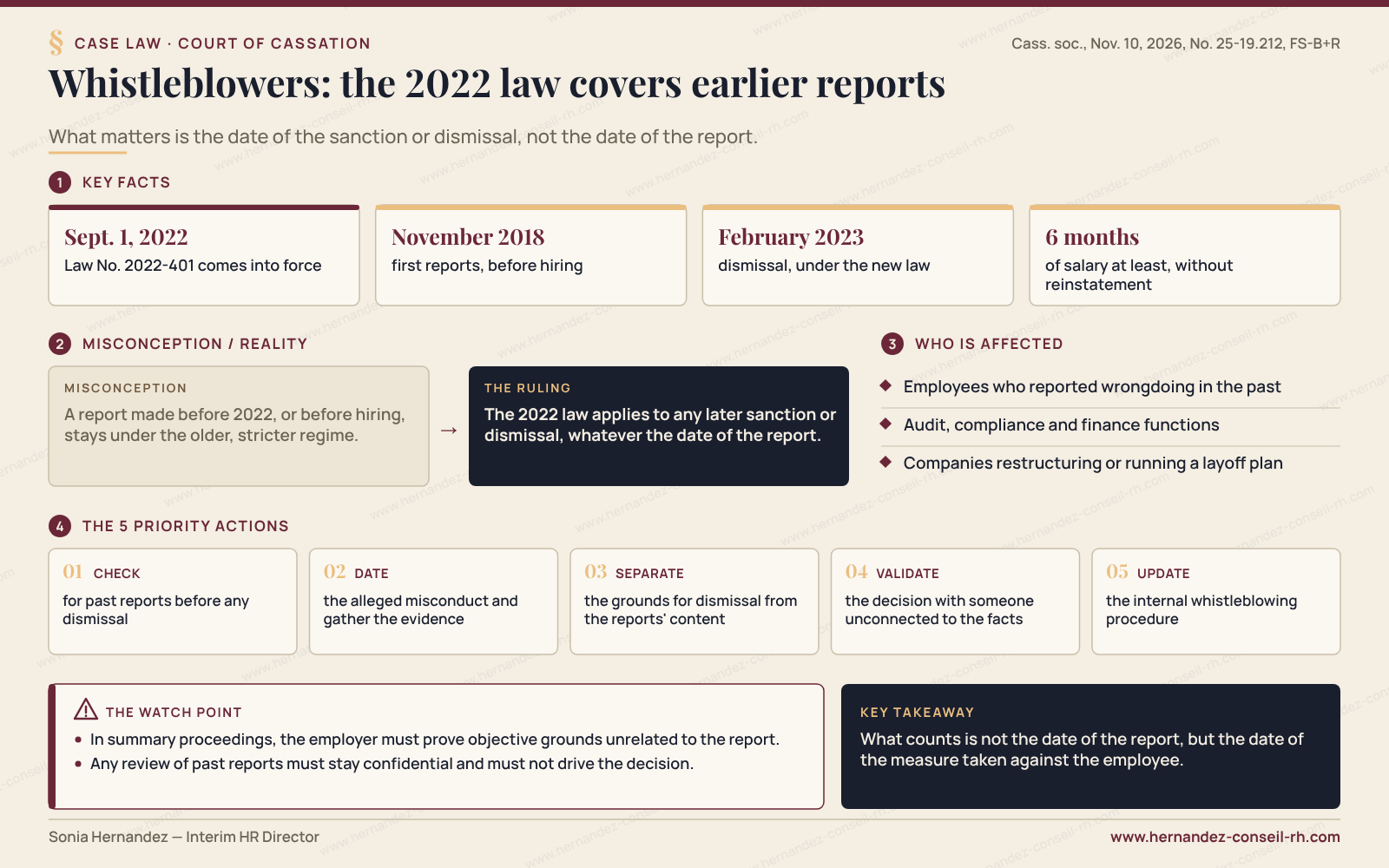
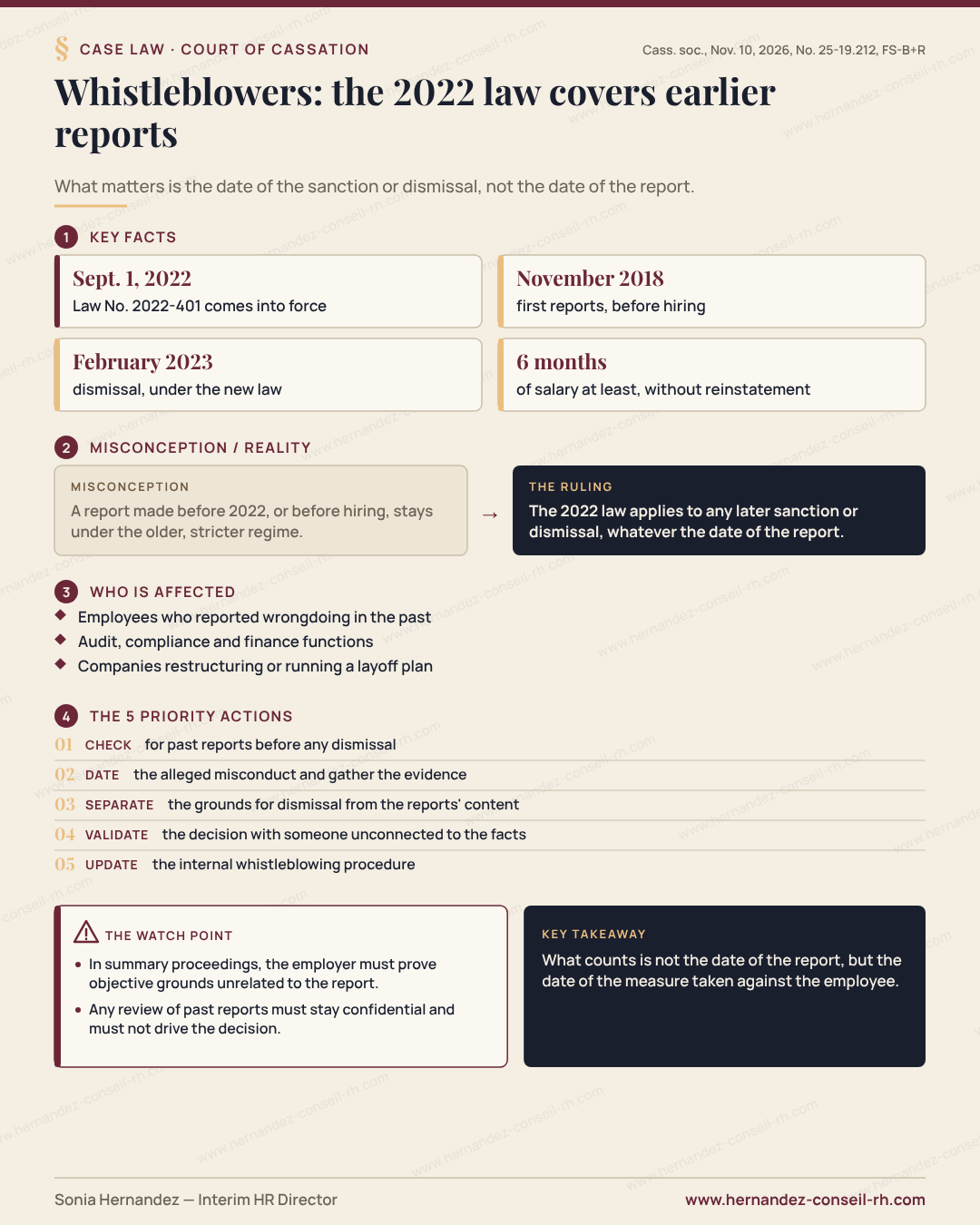
Law No. 2022-401 of March 21, 2022, in force since September 1, 2022, amended the whistleblower regime created by Law No. 2016-1691 of December 9, 2016, known as Sapin II. It broadened the definition of a whistleblower, changed how reports are handled and strengthened protection against retaliation, now set out in Article L. 1121-2 of the French Labor Code (in French) and Article L. 1132-3-3 of the French Labor Code (in French). The open question was which regime applies when the report predates that date and the retaliatory measure comes after it.
In the case decided on November 10, 2026 by the Labor Chamber of the Court of Cassation (No. 25-19.212) (in French), an employee who was then managing director of the AGS, France's wage guarantee scheme, had reported in November 2018, in a memo and emails, facts attributed to the former management of a department run by Unédic, the unemployment insurance body. Hired by Unédic in December 2018 to head that department, with an audit brief, the employee gathered the evidence that led to three criminal complaints being filed in 2019 and 2020. Dismissed for gross misconduct on February 22, 2023, the employee asked the summary judge to declare the dismissal void. In November 2024, the Defender of Rights (France's independent rights ombudsman) recognized the employee as a whistleblower.
The Paris Court of Appeal had rejected the claims: in its view, the facts had been revealed by others and by the Court of Audit, the employee had been hired precisely to audit the department, and the dismissal came more than four years after taking up the post. The Court of Cassation reversed the ruling in full. The 2022 law applies immediately to an employee sanctioned or dismissed after it came into force, regardless of whether the report came earlier, and the trial judges' findings were enough to presume a report had been made. The case goes back to the Paris Court of Appeal, sitting with different judges.
What is at stake
Legal
The Court bases its decision on Article 2 of the French Civil Code: a new law applies immediately to the future effects of ongoing non-contractual legal situations. It specifies that the 2022 law governs both whistleblower status and the protection attached to it. In practice, what counts is the date of the sanction or dismissal, not the date of the report. Employers can therefore no longer rely on the original, stricter 2016 definition against an employee dismissed since September 1, 2022.
Labor relations
Control, audit, compliance and finance functions are directly exposed: their findings can amount to a report, even when produced as part of their job. The Court indeed holds that the audit brief in the contract did not bar protection. For employees, the ruling strengthens trust in whistleblowing channels; for managers, it calls for particular care in handling these profiles.
Financial
A dismissal in breach of this protection is void under Article L. 1132-4 of the French Labor Code (in French). The employee may ask to be reinstated; if they do not, or if reinstatement is impossible, Article L. 1235-3-1 of the French Labor Code (in French) guarantees compensation of at least the last six months' salary, outside the statutory scale. The cost depends mainly on how long proceedings last, as the worked example below shows.
Reputational
A dispute with a whistleblower draws the attention of the media and civil society, as shown by the voluntary intervention of an anti-corruption association, held admissible in this case. For an institution or a company, the reputational damage can far exceed the financial stakes.
Who is affected
Directly affected are:
- employers considering sanctioning or dismissing an employee who has reported wrongdoing, however long ago,
- internal audit, compliance, management control and finance functions, whose reports can amount to whistleblowing,
- companies going through a reorganization or a layoff plan (PSE),
- and employees and employee representatives supporting a whistleblower.
The principle covers sanctions and dismissals after September 1, 2022. Measures taken before that date remain governed by the rules then in force.
What to do
Checklist before a sensitive sanction or dismissal:
- check, with the legal or compliance department, whether the employee has reported wrongdoing in the past, including before being hired or as part of their duties,
- base the decision on dated, proven facts unrelated to the content of the reports,
- have the decision validated by someone unconnected to the facts reported,
- where the job consists of controlling or auditing, make sure the criticism never targets the findings themselves,
- in a layoff plan, be able to trace how the selection criteria were applied, position by position,
- and update the internal procedure for collecting and handling reports, adopted after consulting the works council (CSE).
This review must stay confidential and limited to the legal or compliance department. A list of employees who have blown the whistle, consulted by the managers deciding on a dismissal, could itself be used to prove the link between the report and the measure.
Watch points
- the ruling was given in summary proceedings: it sets the applicable law and the judge's method, without saying the dismissal is void,
- protection is not automatic: the employee must put forward evidence suggesting a report was made, and the employer must then justify its decision,
- a brief set out in the contract, or earlier disclosure of the facts by others, is not enough to deny whistleblower status,
- the time elapsed between the report and the dismissal does not protect the employer,
- and the Defender of Rights' opinion does not bind the judge, but it is among the factors the Court took into account.
In-depth analysis
Scope of the ruling
Handed down by a section panel and published in the official reports and the annual report (ruling No. 921 FS-B+R), the decision relies on Law No. 2016-1691 of December 9, 2016 as amended by Law No. 2022-401, in particular its Article 10-1, III on the burden of proof, and on Articles L. 1132-3-3, L. 1132-4 and R. 1455-6 of the French Labor Code. It makes three points:
- the 2022 law applies immediately, both to whistleblower status and to protection, to any employee sanctioned or dismissed after September 1, 2022, even if the report came earlier,
- information obtained in the course of professional activities need not have been personally known to the person reporting it, which disposes of the objection that the facts had been revealed by others,
- and the summary judge, faced with a dismissal following a report, must first assess whether the evidence suggests a good-faith report, then examine whether the employer proves that its decision rests on objective grounds unrelated to that report.
Publication in the annual report underlines the importance the Court attaches to this transitional rule, which is set to apply in many cases opened since 2022.
What practitioners say
Xavier Berjot, attorney, Village de la Justice, November 12, 2026. The article (in French) holds that the decisive criterion is the date of the contested measure, not the date of the report. It stresses that neither a report predating the hiring nor an audit brief is enough to deny protection, and it details the summary judge's two-step review.
Frédéric Chhum, attorney, and Léa Fakhreddine, Village de la Justice, November 17, 2026. The authors of this article (in French) emphasize the summary judge's duty to end a manifestly unlawful disturbance, even where there is a serious dispute. They see it as strengthening the effectiveness of the protection, assessed under the law in force on the day of the retaliation.
On the internal reporting procedure, two 2022 overviews remain useful: Open Lefebvre Dalloz (in French) of November 10, 2022, on the obligations of companies with at least 50 employees, and CMS Francis Lefebvre (in French) of October 6, 2022, on how the procedure works.
Open questions
The ruling settles the applicable law and the summary judge's method. Other points remain to be clarified:
- which objective grounds the employer can rely on when the alleged misconduct concerns the conduct of the audit itself, that is, the very activity that fed the report,
- how much weight the time between the reports and the dismissal carries in assessing the link between them,
- how continuing situations are treated, such as sidelining that began before September 1, 2022 and was followed by a dismissal after that date,
- the evidential value of the Defender of Rights' opinion, which adds to the other evidence without binding the judge,
- and the outcome on the merits: the court on remand will have to decide whether the gross misconduct rests on grounds unrelated to the reports.
The risk in figures
The nullity of the dismissal follows from Article L. 1132-4 of the French Labor Code (in French). Without reinstatement, Article L. 1235-3-1 of the French Labor Code (in French) sets a floor of six months' salary, without applying the scale in Article L. 1235-3 of the French Labor Code (in French). With reinstatement, the employee can claim the salary for the period of exclusion, subject to the rules on deducting income received in the meantime, to be checked case by case.
Illustrative example only: a manager with 8 years' service, paid 9,000 euros gross a month, dismissed after September 1, 2022 for facts the employer cannot separate from the report. If reinstatement is ordered 18 months after the dismissal, back pay comes to 162,000 euros gross, about 234,900 euros with employer social charges estimated at 45%. Without reinstatement, the statutory minimum of six months is 54,000 euros, plus notice, assumed to be three months (27,000 euros and 2,700 euros of paid leave), and statutory severance pay (18,000 euros), at least 101,700 euros in all. Each additional month of proceedings costs about 13,000 euros, including charges, in the reinstatement scenario.
The employee representatives' perspective
For the works council and union delegates, the ruling first has a collective dimension. In companies with at least 50 employees, the internal reporting procedure is adopted after consulting the works council. Representatives can check that it exists, that it has been circulated, that it sets out the external reporting channels and that its deadlines are met. In a reorganization or layoff plan, they can ask management to guarantee that the selection criteria take no account of past reports, without asking for names, since whistleblowers' identities are confidential.
At the individual level, the ruling gives representatives an immediate argument. An employee who reported wrongdoing before September 1, 2022 and has been sanctioned or dismissed since can rely on the 2022 regime, with its broader definition and eased burden of proof. The union delegate can encourage the employee to gather early the dated evidence of the reports, their recipients and their follow-up, and to consider referring the matter to the Defender of Rights, whose opinion counted in this case.
Cross perspectives
The employment lawyer's view
The ruling resolves a conflict of laws over time on the basis of Article 2 of the French Civil Code: protection is assessed under the law in force on the day of the sanction or dismissal, not on the day of the report. Its exact scope should still be measured. Given in summary proceedings, it sets the method for the judge dealing with clear-cut cases, who first checks whether the evidence suggests a report, then whether the employer proves objective grounds unrelated to it. It does not hold that the dismissal is void: the court on remand will still have to assess the gross misconduct.
The employee-side lawyer's view
In pending cases, the ruling closes off a common defense: relying on the earlier, stricter definition against an employee who blew the whistle before September 2022. An audit brief set out in the contract does not bar protection, nor does prior disclosure of the facts by others. Summary proceedings become a realistic route to seek reinstatement again, provided the employee builds an early file that dates each report and records its recipients and follow-up, whether criminal complaints or a referral to the Defender of Rights.
The group HR director's view
Before any dismissal, including in a reorganization, I check with the legal department whether the employee has reported wrongdoing, even long ago, even before being hired. More than four years since the report does not protect the employer. The grounds must rest on dated, proven facts unrelated to the content of the reports. Where the job is precisely to control or audit, even more caution is needed: poorly supported gross misconduct exposes the company to reinstatement ordered as a matter of urgency.
The compliance officer's view
Companies with at least 50 employees must have an internal reporting procedure, adopted after consulting the works council. Decree No. 2022-1284 of October 3, 2022 requires an acknowledgment of receipt within seven working days and feedback within three months at most. The ruling shows that control functions are the most exposed, since their reports can amount to whistleblowing. It helps to distinguish, in the files, audit deliverables from whistleblowing reports, and to keep a record of how they were handled.
The data protection officer's view
Searching for past reports before a dismissal means accessing data that the law protects strictly. Article 9 of the Sapin II Act (in French) guarantees the confidentiality of the identity of the people who make a report, of the people named in it and of the information gathered; disclosing them is punishable by two years' imprisonment and a €30,000 fine. Any check must therefore go through the people in charge of handling reports, who answer a specific question without opening the file to HR. The same article limits how long reports may be kept to what is strictly necessary to handle them and to protect the people concerned, and the CNIL guidelines on whistleblowing schemes (in French), updated in July 2023, set out how. The record of processing activities should reflect these rules.
Sonia Hernandez, Interim HR Director — November 23, 2026
General information current as of November 23, 2026; it does not constitute legal advice.