Contents
The issue
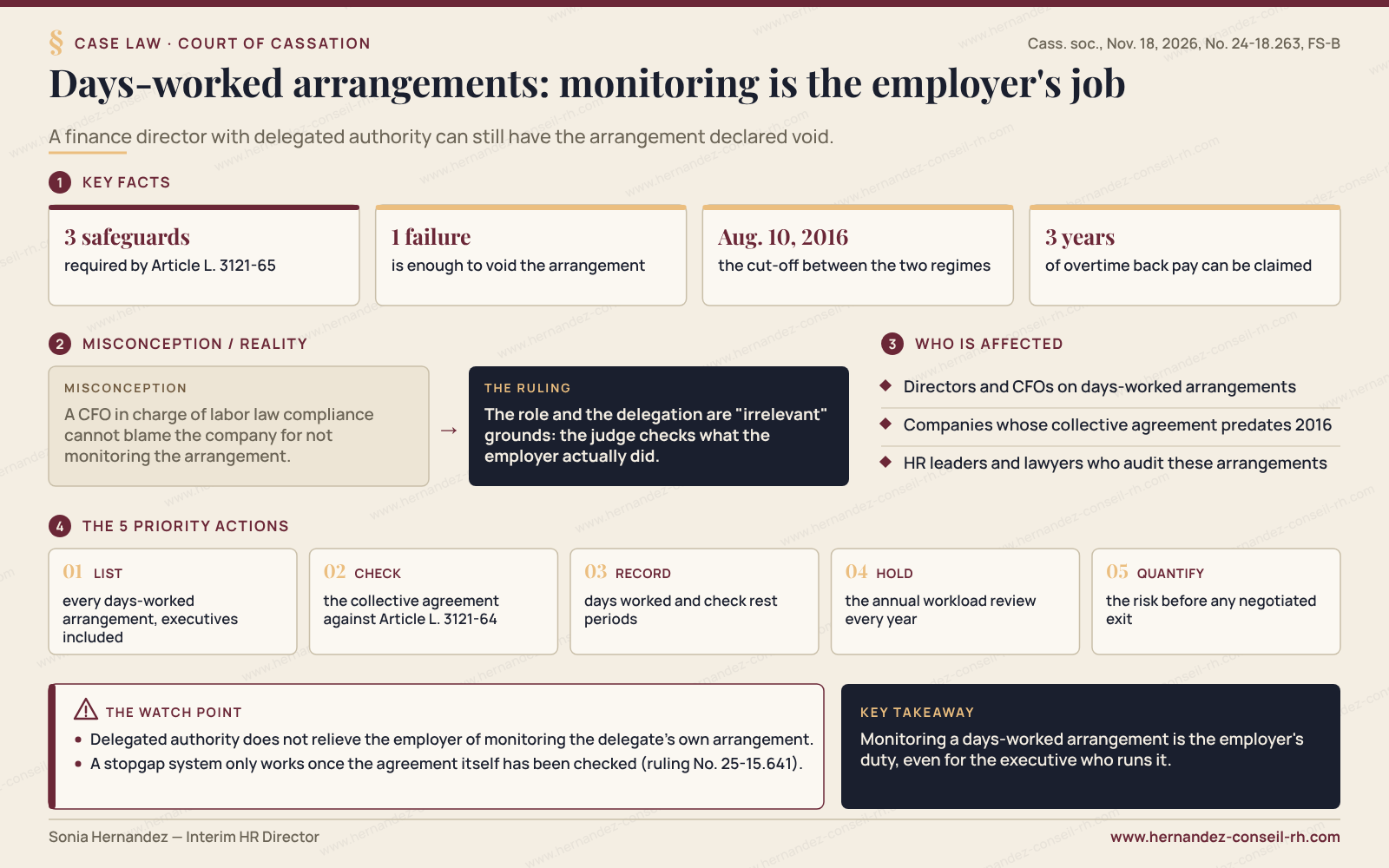
Under French law, an annual days-worked arrangement (forfait jours) lets companies count the working time of autonomous managers in days rather than hours. In return, the employer must regularly make sure their workload stays reasonable, as required by Article L. 3121-60 of the French Labor Code (in French), a public policy provision. Where the collective agreement does not provide for the workload monitoring and periodic discussions required by items 1 and 2 of section II of Article L. 3121-64 of the French Labor Code (in French), Article L. 3121-65 of the French Labor Code (in French) allows an arrangement to be concluded or continued on three conditions: a record of the days worked, a check that rest periods are respected and an annual review of the workload. That leaves a practical question: what happens when the employee is precisely the person who was supposed to organize that monitoring?
In the case decided on November 18, 2026 by the Labor Chamber of the Court of Cassation (No. 24-18.263) (in French), an employee had been hired in March 2014 as site director and administrative and finance director of a textile cleaning and rental company. The employment contract made the director responsible for ensuring compliance with labor obligations and supervising personnel administration; a delegation of authority also covered the application of labor law. Dismissed in June 2018, the employee challenged the validity of the arrangement and claimed overtime for the period from July 2015 to October 2018.
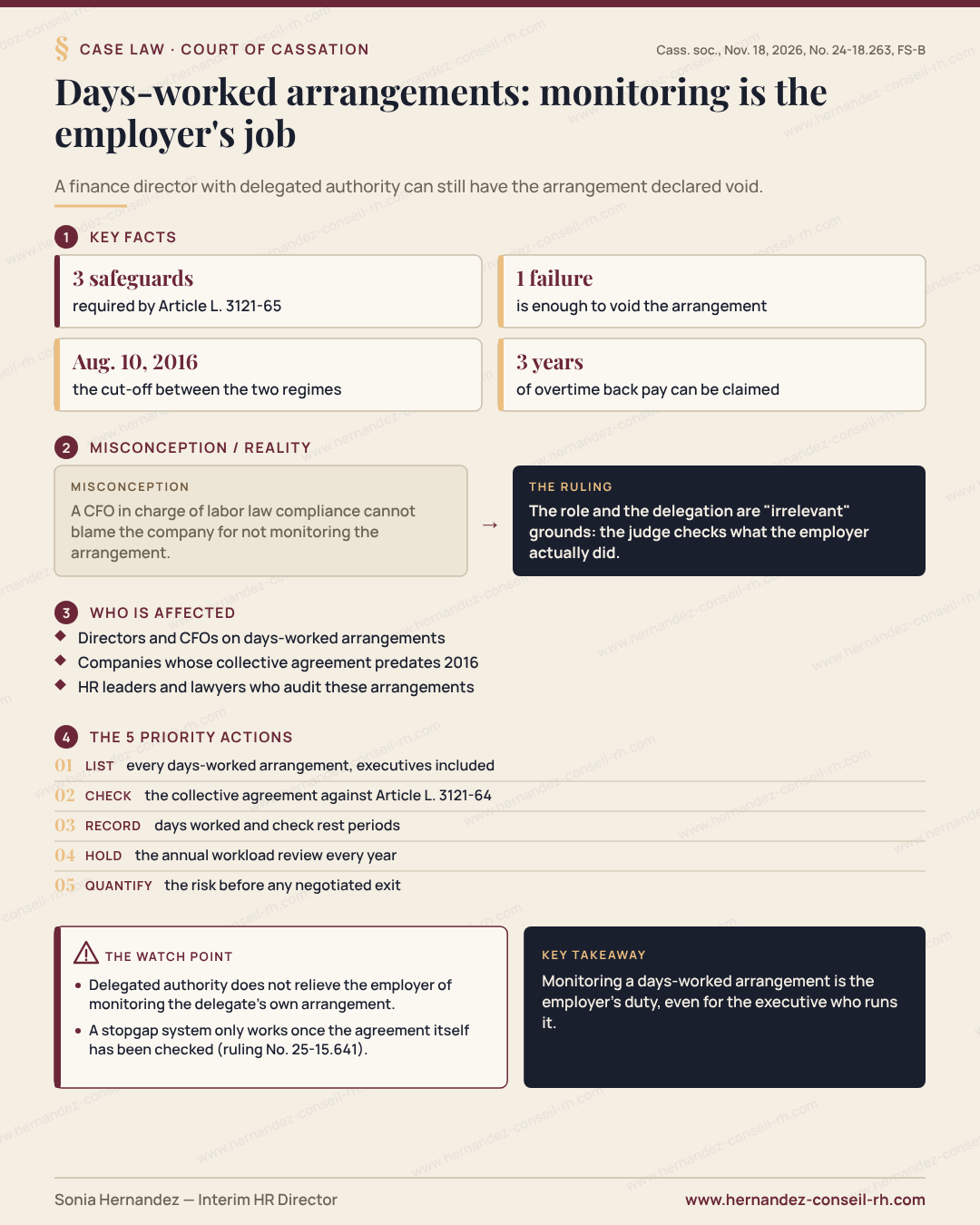
The Colmar Court of Appeal had dismissed the claim: since the director had not monitored any of the arrangements, nor alerted group management, the director could not, in the court's view, rely on their own failings. The Court of Cassation reversed in two steps. Before August 10, 2016, the company agreement of February 28, 2006 and the national agreement of January 28, 2000 did not make it possible to remedy an excessive workload in good time: the arrangement was void. After that date, a failure by the employer to meet any one of the three statutory safeguards is enough to make it void, and the employee's duties and delegation are "irrelevant" grounds for setting that aside. The case goes back to the Metz Court of Appeal.
What is at stake
Legal
The ruling confirms that workload monitoring is an employer obligation, which neither the employment contract nor a delegation shifts onto the employee concerned. The statute points the same way: the employee may fill in the record of days worked, but "under the employer's responsibility." The ruling does not call delegations of authority into question generally; it only holds that a delegation cannot be used to defeat the nullity of the delegate's own arrangement. On the same day, a second published ruling (No. 25-15.641 (in French)) adds that where the employer sets up a system to make up for the shortcomings of the collective agreement, the judge must first check whether that agreement complies with the law.
Labor relations
Executives are often missing from workload monitoring. They are assumed to control their own time, and they are sometimes in charge of organizing that monitoring for everyone else. The ruling is a reminder that the right to health and rest applies to them too, and it gives employee representatives an argument for demanding effective monitoring of every arrangement.
Financial
Once the arrangement is void, the employee falls back under the ordinary working time rules. Overtime can be claimed for the three years before the employment ended, under Article L. 3245-1 of the French Labor Code (in French), with the premiums set by the collective agreement or, failing that, by statute. For an executive with a high hourly rate, the amounts quickly become significant, as the worked example below shows.
Reputational
A dispute pitting a company against its former finance director over the monitoring of that director's own workload is hard to explain, internally as well as to an auditor or a buyer. It exposes a gap in internal control on an occupational health issue.
Who is affected
Directly affected are:
- executives on days-worked arrangements, in particular finance directors, site directors and HR managers responsible for labor law compliance,
- companies whose collective agreement on days-worked arrangements predates the Law of August 8, 2016 or covers neither workload monitoring nor the right to disconnect,
- groups that entrust the HR management of their subsidiaries to a director with delegated authority,
- and buyers and investors assessing a target's employment liabilities.
Senior executives (cadres dirigeants) within the meaning of Article L. 3111-2 of the French Labor Code (in French) fall outside the working time rules, but that status requires cumulative criteria assessed against the duties actually performed. It cannot serve as a fallback once the arrangement is challenged.
What to do
Checklist to secure days-worked arrangements, executives included:
- review the applicable collective agreement against items 1 to 3 of Article L. 3121-64, II and, if it falls short, apply the safeguards of Article L. 3121-65 without delay,
- list every individual arrangement, including those of executive committee members,
- keep, for each employee, a record of the full and half days worked,
- check, on the basis of documents, that daily and weekly rest periods are respected,
- hold an annual review of workload, work organization, work-life balance and pay, led by the employee's line manager,
- keep dated minutes, year by year,
- and quantify the risk before any negotiated exit with an executive.
For a finance or HR director who runs these systems, monitoring of their own arrangement should be entrusted to their line manager, for example the CEO. It is the simplest way to avoid repeating the situation in this case.
Watch points
- a delegation of authority remains useful, but it does not validate the delegate's own arrangement,
- ruling No. 25-15.641 of the same day requires the collective agreement to be checked before relying on a stopgap system,
- nullity does not mean automatic liability: the employee still has to back up the hours claimed,
- compensation for undeclared work requires intent on the employer's part, which the court on remand will have to assess,
- and an annual review cannot be presumed: there must be a record of it.
In-depth analysis
Scope of the ruling
Handed down by a section panel and published in the Court's official reports (ruling No. 960 FS-B), the decision relies, for the period after August 10, 2016, on Articles L. 3121-60 and L. 3121-65, I of the French Labor Code and on Article 12, III of Law No. 2016-1088 of August 8, 2016. It makes three points:
- before August 10, 2016, the Court applies its case law based on the right to health and rest: an agreement that does not make it possible to remedy an excessive workload in good time cannot support a days-worked arrangement,
- since that date, a single failure by the employer to meet the three safeguards of Article L. 3121-65 deprives it of the exemption, and an arrangement based on a deficient agreement is void,
- and the judge must check that the employer actually applied these safeguards, without stopping at the employee's duties and delegation.
The ruling No. 25-15.641 of the same day (in French), also published, concerns a data protection officer. The Court of Appeal had found that the workload had been monitored beyond what the collective agreement required. The Court of Cassation reversed: where the employer runs a system that makes up for the agreement's shortcomings without replacing it, the agreement's compliance must be checked first. Both decisions point the same way: a secure arrangement is built first in the agreement, then through monitoring that the employer must be able to prove.
What practitioners say
Open Lefebvre Dalloz, "Une semaine de jurisprudence sociale à la Cour de cassation," November 23, 2026. The weekly case law roundup (in French) presents the ruling by distinguishing the two periods and picks up the wording on irrelevant grounds drawn from the duties and responsibilities entrusted to the employee. It also flags ruling No. 25-15.641 of the same day on continuing an arrangement based on a non-compliant agreement.
At the time of writing, published commentary was limited to these weekly roundups. More detailed analyses are expected in the specialist law journals.
Open questions
The ruling settles the validity of the arrangement, not its consequences. Several points remain to be clarified:
- how an executive who organizes their own time and often works off-site can prove the hours worked,
- how intent to conceal is assessed when the employee was in charge of payroll and labor law compliance,
- what happens to rest days granted under a void arrangement, which the employer may want to offset against the claim,
- where the line falls between a system that makes up for an agreement's shortcomings and one that replaces it,
- and whether the delegate could be liable to the employer for failing to organize monitoring for other employees.
The Metz Court of Appeal will have to rule on back pay, compensatory rest, undeclared work and unfair performance of the contract.
The risk in figures
Once the arrangement is void, hours worked beyond 35 a week are overtime. Absent an agreement, the first eight carry a 25% premium under Article L. 3121-36 of the French Labor Code (in French), and the claim can cover the three years before the employment ended. If the judge finds undeclared work within the meaning of Article L. 8221-5 of the French Labor Code (in French), which requires intentional concealment, Article L. 8223-1 of the French Labor Code (in French) also provides for a lump-sum compensation of six months' salary.
Illustrative example only: a finance director paid 10,000 euros gross a month. That salary corresponds to 151.67 hours a month, an hourly rate of 65.93 euros. If the director proves 43 hours a week, that is 8 overtime hours at a premium rate of 82.42 euros, over 44 weeks a year, the back pay comes to 29,010 euros a year and 87,031 euros over three years, then 95,734 euros with the related paid leave. If intent to conceal is established, the lump-sum compensation adds 60,000 euros, about 155,700 euros in total, before employer social charges, compensatory rest, damages and legal costs.
The employee representatives' perspective
For union delegates, the ruling is a reminder that the collective agreement is the first safeguard of a days-worked arrangement, and it shows the cost of old agreements that stop at an indicative calendar and a monthly form. The agreement must cover workload monitoring, communication between employee and employer and the right to disconnect, which Article L. 3121-65, II (in French) ties, in companies with at least 50 employees, to the charter provided for in item 7 of Article L. 2242-17 (in French). Negotiations on quality of working life are an opportunity to bring these clauses up to standard.
For the works council (CSE), the lesson is broader. Executives and autonomous managers are often missing from working time indicators, even though they carry heavy workloads. Representatives can ask how many employees are on days-worked arrangements, how and how often workload reviews are held, and what follow-up is given to alerts. The aim is not to put the managers concerned on the spot, but to check that monitoring exists for everyone, including those who administer it.
Cross perspectives
The employment lawyer's view
The ruling creates no new obligation. It restates that the safeguards of a days-worked arrangement rest on the employer and that the judge must check they were applied. Its significance lies in the context: the Court of Appeal had held that the employee could not rely on their own failings, since the employee was responsible for enforcing labor law. The Court rules those grounds irrelevant. A delegation organizes how authority is exercised within the company; it does not allow the employer to hold the delegate responsible for the lack of monitoring of the delegate's own arrangement.
The employee-side lawyer's view
For a dismissed executive, the days-worked arrangement becomes a way into litigation. The ruling closes off a common defense, which is to blame the employee for not organizing the very monitoring they complain about. The hours worked still have to be backed up, and a director often has usable evidence: emails, calendar, committee minutes. A claim for undeclared work, on the other hand, requires proof of the employer's intent; it does not follow from the nullity of the arrangement alone.
The group HR director's view
The first step is to list the executives on days-worked arrangements. For each, three documents need checking: the record of days worked, evidence of regular workload monitoring and the minutes of the annual review. These executives are often the ones nobody monitors, because they are supposed to monitor everyone else. If the agreement is old, ruling No. 25-15.641 requires it to be tested against the statutory requirements first: good monitoring does not cure a deficient agreement, and any remediation only applies going forward.
The CFO's view
This is also an internal control issue. The ruling shows that the risk attached to a delegated director's arrangement stays with the company. Such a liability rarely appears in the accounts until a claim is made; it therefore needs to be estimated for the exposed population, with explicit assumptions on hours and pay, then addressed in acquisition due diligence and warranty clauses. Before a negotiated exit with a salaried executive, this risk weighs directly on the settlement amount.
The occupational physician's view
Under Article L. 3121-62 of the French Labor Code (in French), the days-worked arrangement removes the maximum working hours, but not the rest periods: eleven consecutive hours a day under Article L. 3131-1 of the French Labor Code (in French), and twenty-four hours a week plus those eleven hours under Article L. 3132-2 of the French Labor Code (in French). Among senior managers, a lack of workload monitoring often shows up as entrenched fatigue and sleep problems that the person is slow to report. During check-ups, the occupational physician may propose in writing adjustments to working time, as provided by Article L. 4624-3 of the French Labor Code (in French). The employer must take them into account and, if it refuses, give its reasons in writing to the employee and the physician, under Article L. 4624-6 of the French Labor Code (in French). The annual workload interview and the medical follow-up should be consistent with each other: these documents will be reread if a dispute arises.
Sonia Hernandez, Interim HR Director — November 23, 2026
General information current as of November 23, 2026; it does not constitute legal advice.