Contents
The issue
The right to strike protects employees against any sanction or discriminatory measure, particularly regarding pay, as Article L. 2511-1 of the French Labor Code (in French) expressly provides. The employer nonetheless keeps running the business. It may try to keep operations going, provided it does not use fixed-term contracts or temp workers to replace strikers, which Article L. 1242-6 of the French Labor Code (in French) and Article L. 1251-10 of the French Labor Code (in French) prohibit. Where business continuity ends and pressure on strikers begins is debated in every dispute.
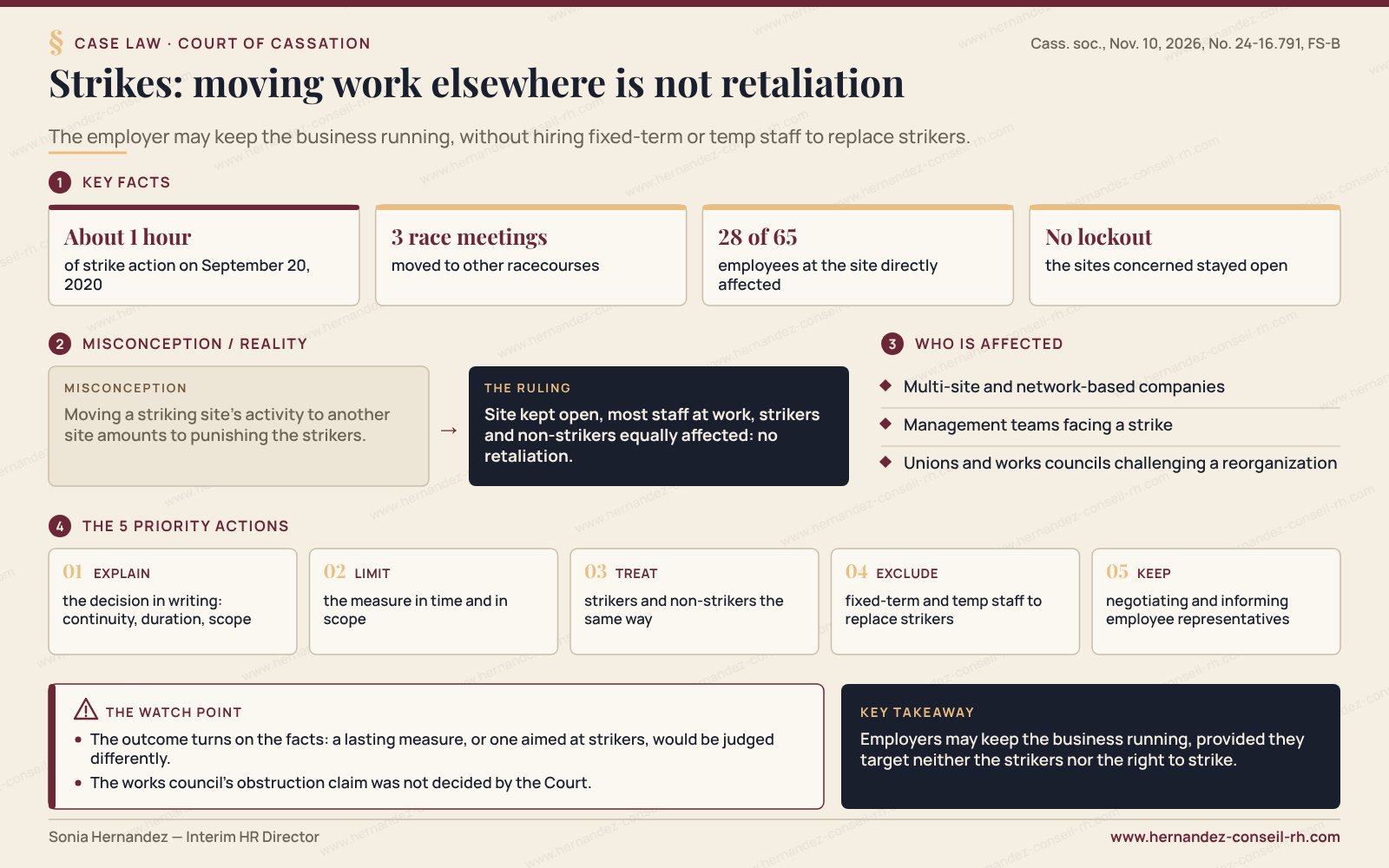
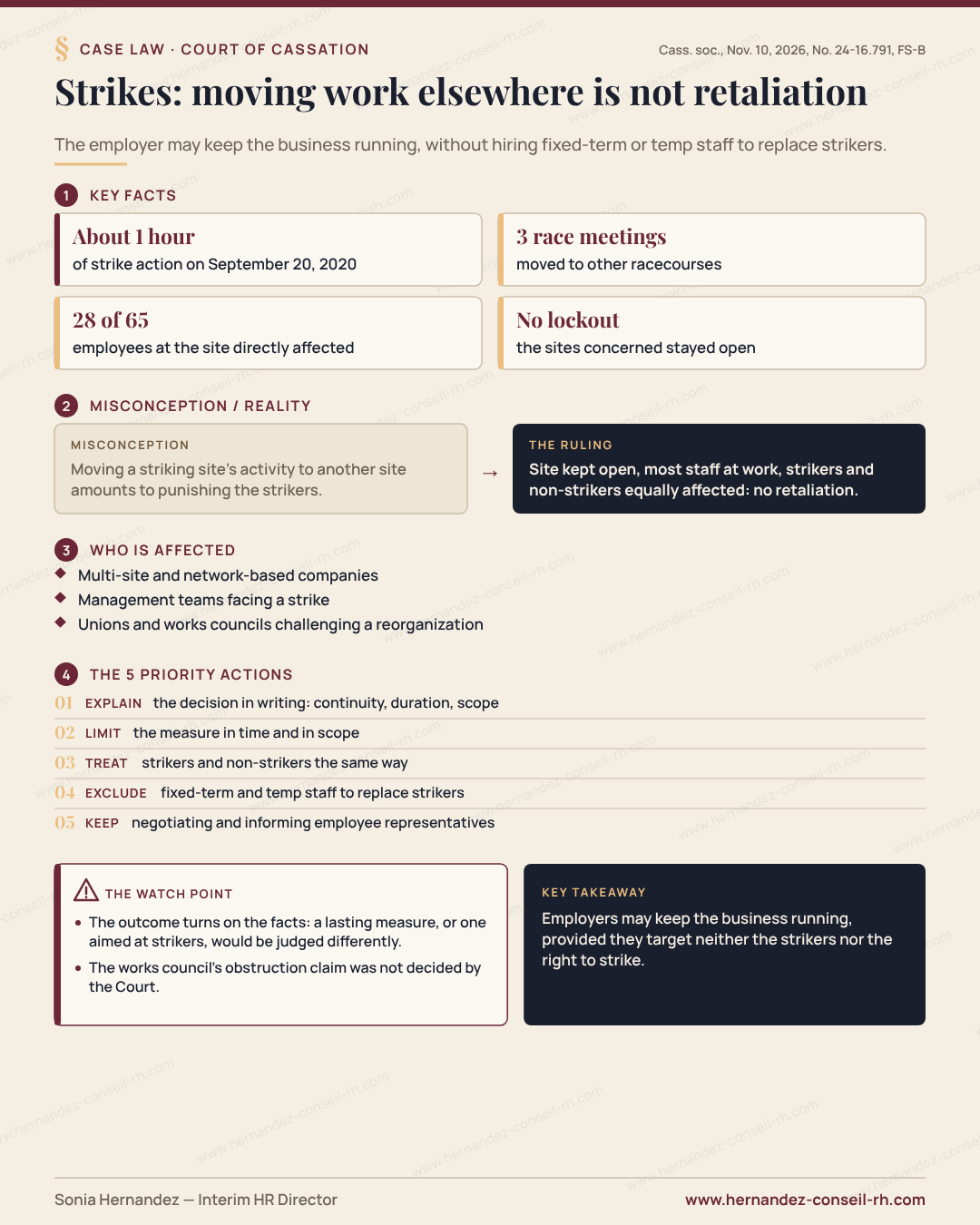
In the case decided on November 10, 2026 by the Labor Chamber of the Court of Cassation (No. 24-16.791) (in French), an association that organizes horse races employed some two hundred people across several racecourses. On September 20, 2020, at a union's call, employees demonstrated trackside for about an hour, delaying the start of the races. Citing the uncertainty caused by the movement, and while negotiations continued, management moved the race meetings of September 22, 24 and 25 to two other racecourses. Some staff were placed on short-time work and lost the bonuses tied to those races.
In a case brought by the union and the works council (CSE), the Paris Court of Appeal had found the relocation to be retaliatory, awarded the union 2,000 euros and upheld the claim for the bonuses to be paid. The Court of Cassation reversed: the sites stayed open, which rules out a lockout; most staff carried out their usual duties; only 28 of the site's 65 employees were directly affected; and those who lost part of their pay included both strikers and non-strikers. The case goes back to the Paris Court of Appeal, sitting with different judges.
What is at stake
Legal
Relying on Article L. 2511-1, the Court restates that during a strike the employer may organize the business to keep it running, subject to the bans on fixed-term and temp replacements. It creates no new rule, but it sets out what the judge must examine before finding retaliation: whether the sites stayed open, the share of employees affected and whether the measure hit strikers and non-strikers alike. The fact that the decision was taken in response to the movement is not enough to make it unlawful.
Labor relations
For employees, lost bonuses remain the most visible consequence, whether they went on strike or not. The ruling rules out retaliation precisely because non-strikers were penalized too, which may be poorly understood on the ground. A reorganization during a dispute therefore needs to be explained, or it risks hardening the very movement it sought to contain.
Financial
The amounts at stake were modest: 2,000 euros in damages for the union and the payment of race bonuses. Yet the litigation lasted more than four years after the January 2022 summons. The payslips of the 28 employees placed on short-time work had been corrected in November 2021, after the labor inspectorate stepped in.
Reputational
A decision seen as a response to a strike can damage the workplace climate and the employer brand for a long time, even when it is legally sound. How it is presented to employees and their representatives matters as much as its legality.
Who is affected
Directly affected are:
- companies with several sites, establishments or outlets that can temporarily transfer production or an event,
- HR and operations teams responsible for business continuity during a dispute,
- unions and works councils challenging a reorganization decided during a strike,
- and employees, striking or not, part of whose pay depends on the relocated work.
The ruling concerns a temporary, limited relocation. It says nothing about a permanent transfer of work, which is governed by other rules, including consulting the works council on the general running of the company.
What to do
Checklist for reorganizing work during a strike:
- put the decision and its business continuity reason in writing, specifying its duration and scope,
- keep the sites concerned open, unless exceptional circumstances would justify closing them,
- refrain from using fixed-term contracts or temp workers to replace strikers,
- apply the same pay, bonus and short-time work rules to every employee affected, striking or not,
- keep negotiating and inform employee representatives of the measures taken,
- and keep the rosters, the lists of employees concerned and the payslips.
The treatment of variable bonuses tied to the relocated work deserves particular attention: it is often what crystallizes the dispute, far more than the reorganization itself.
Watch points
- the outcome rests on specific facts: a longer measure, or one aimed only at strikers, could be characterized differently,
- closing a site on strike is a lockout, allowed only in exceptional circumstances,
- the reversal only concerns the claims based on infringement of the right to strike: the works council's obstruction claim was not decided by the Court,
- the payslip corrections made after the labor inspectorate stepped in show that payroll must be checked as soon as the decision is taken,
- and publication in the official reports gives weight to the principle, not to a mechanical application of the figures in this case.
In-depth analysis
Scope of the ruling
Handed down by a section panel and published in the Court's official reports (ruling No. 942 FS-B), the decision relies on Article L. 2511-1 of the French Labor Code. It reaffirms the employer's freedom to organize the business, limited by any infringement of the right to strike. It does not settle the whole dispute: the reversal covers the 2,000 euros awarded to the union, the bonus payments claimed on the basis of infringement of the right to strike and the legal costs, and the case goes back to the Paris Court of Appeal.
The decision must be distinguished from a lockout. In a ruling of December 17, 2013 (No. 12-23.006) (in French), the Labor Chamber upheld judges who had found unlawful, and an obstruction of the right to strike, the closure of a company decided without any proven assault or security threat. In 2026, the sites had stayed open: that is the first criterion the Court used to rule out retaliation.
What practitioners say
Isabelle Vénuat, Éditions Tissot, November 16, 2026. The article (in French) boils the ruling down to three elements: the limited duration of the measure, the absence of a lockout and a loss of bonuses borne by strikers and non-strikers alike. It draws a simple test from it: a proportionate measure that does not prevent the movement and does not target strikers. It also lists the means available to the employer to keep operating, such as calling on non-strikers, subcontracting or secondment within the group, and those that are prohibited, first among them using fixed-term or temp staff to replace strikers.
At the time of writing, no other accessible commentary on the ruling had been published. The decision had attracted little comment so far.
Open questions
The Court sets out a method without fixing a threshold. Several points remain to be clarified:
- the duration, or share of employees affected, beyond which a temporary relocation would become a way of putting pressure on strikers,
- whether non-strikers are entitled to the lost bonuses on a basis other than the right to strike, in particular under their contracts,
- whether short-time work could lawfully be used for employees left without work by a strike-related reorganization, which the ruling does not address,
- and the role of informing or consulting the works council when a reorganization is decided in the middle of a dispute.
The Paris Court of Appeal, sitting with different judges, will have to rule again on the points reversed.
The risk in figures
Where the judge finds retaliation, the legal basis is Article L. 2511-1 of the French Labor Code (in French), which prohibits any discriminatory pay measure linked to the exercise of the right to strike. The risk combines back pay for employees, damages for the union and legal costs.
Illustrative example only: 28 employees deprived of an 80-euro gross bonus for three days of relocated work. The back pay comes to 6,720 euros gross, about 9,400 euros with employer social charges estimated at 40%. Add damages for the union, for example 2,000 euros as awarded on appeal in this case, and legal costs of a few thousand euros: about 14,400 euros in total with 3,000 euros of costs. The amount remains limited; the real cost lies in the length of the litigation and its effect on the workplace climate. By comparison, replacing strikers with fixed-term or temp workers is punishable by a 3,750-euro fine, rising to 7,500 euros and six months' imprisonment for a repeat offense (Article L. 1248-3 and Article L. 1255-5 of the French Labor Code (in French)).
The employee representatives' perspective
The ruling does not leave representatives without recourse, but it shifts the debate. The mere fact that work is moved during a dispute is no longer enough to establish retaliation: it must be shown that the measure targets strikers, or goes beyond what continuity requires. The useful indicators are those the Court examined: the duration of the measure, the share of staff affected, whether the site was open or closed and how pay losses were distributed. Representatives should document them from the start of the dispute, with rosters, lists of employees concerned and payslips.
For the works council, part of the case remains open, since the Court did not rule on its obstruction claim. The question of how it is informed of a reorganization decided in the middle of a dispute therefore remains relevant. As for non-striking employees, their right to the lost bonuses could be argued on a basis other than the right to strike; the ruling leaves that avenue open.
Cross perspectives
The employment lawyer's view
The ruling creates no new rule: it restates that the employer may organize the business to keep it running, subject to the bans on using fixed-term or temp staff to replace strikers. Its value lies in the method of review. The Court checks for the absence of a lockout, the share of employees directly affected and whether the pay loss hit strikers and non-strikers alike. These indicators are factual: a longer relocation, or one aimed at striking staff, could be characterized differently.
The union delegate's view
The message is uncomfortable for union teams. A one-hour strike was followed by the transfer of three race meetings, and employees, striking or not, lost bonuses. The Court notes that non-strikers were penalized too in order to rule out retaliation; the argument can be turned around, since the measure weighed on the whole workforce and may discourage future action. The union will watch the duration and repetition of such transfers, and ask why particular sites and dates were chosen.
The labor inspector's view
Inspections focus first on what can be verified: no fixed-term or temp workers assigned to strikers' jobs, and how payroll was handled. This case illustrates the point, since the payslips of the 28 employees placed on short-time work were only corrected after the inspectorate stepped in, in November 2021. Faced with a reorganization decided during a strike, the inspector will likely ask for the reasons behind the decision, the list of employees concerned and their payslips.
The group HR director's view
For a multi-site group, the ruling validates a familiar lever: temporarily transferring production or an event to another site. The employer still has to be able to prove, with documents, the continuity reason, the limited duration of the measure, that the striking site stayed open and that no distinction was made between strikers and non-strikers. I advise putting the decision in writing, informing employee representatives, continuing negotiations and dealing with bonuses up front, as they remain the most visible point of friction.
The CFO's view
Moving work elsewhere has a cost: transport, set-up at the receiving sites, hours and bonuses for the staff involved, and possibly lost revenue. I put a figure on it before the decision and document it, because the business continuity reason is also shown in the accounts: a measure whose cost clearly exceeds the loss it avoids could be read as a sanction. On payroll, the striker's pay deduction must be exactly proportional to the time stopped, and an attendance-related bonus may be reduced only if all absences, other than those treated as actual work, have the same effect, as the Ministry of Labor guidance on strikes (in French) points out. I would have the payslips of the employees affected by the move checked in the month concerned: in this case, the correction came only after the labor inspectorate stepped in.
Sonia Hernandez, Interim HR Director — November 23, 2026
General information current as of November 23, 2026; it does not constitute legal advice.