Contents
The issue
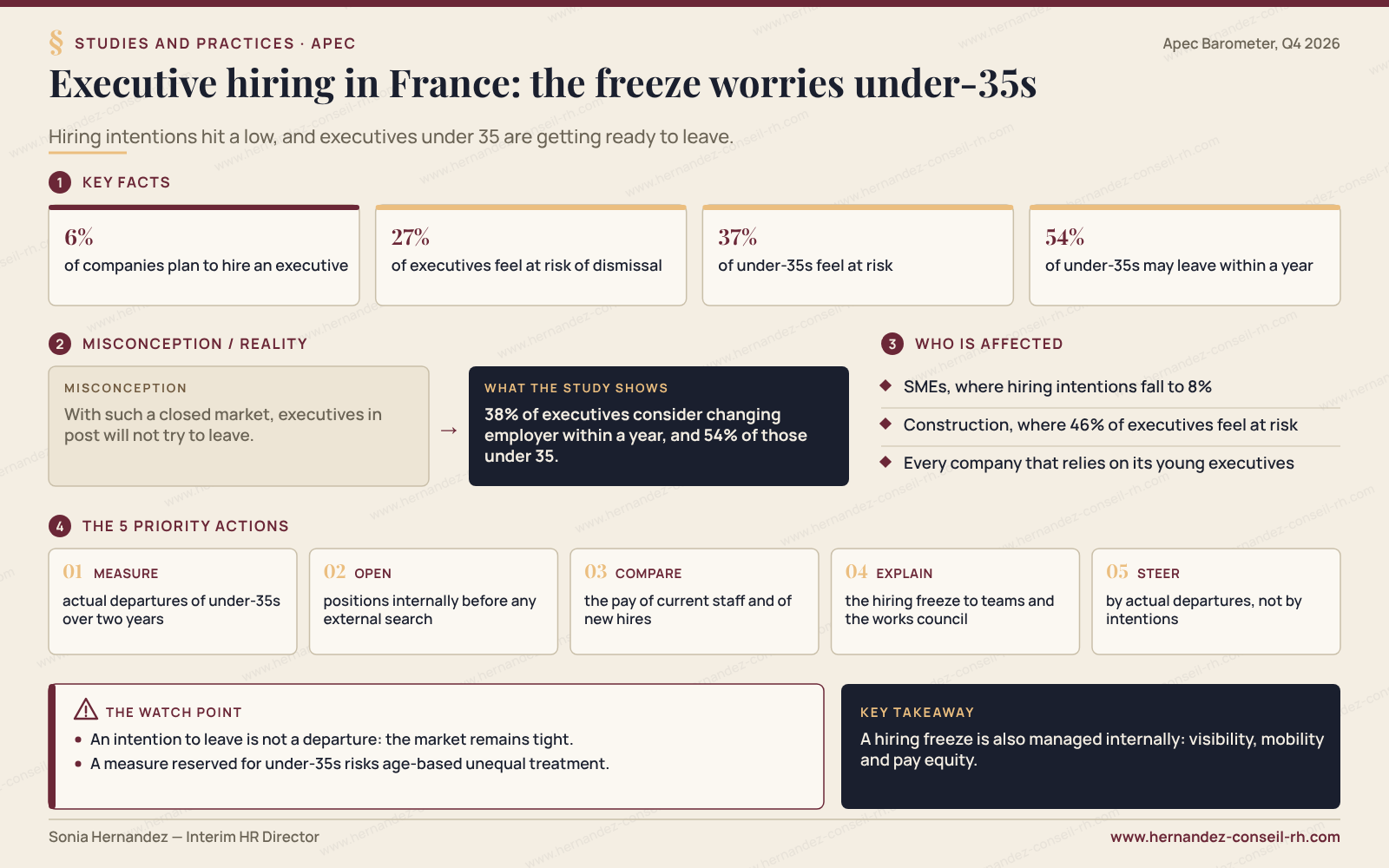
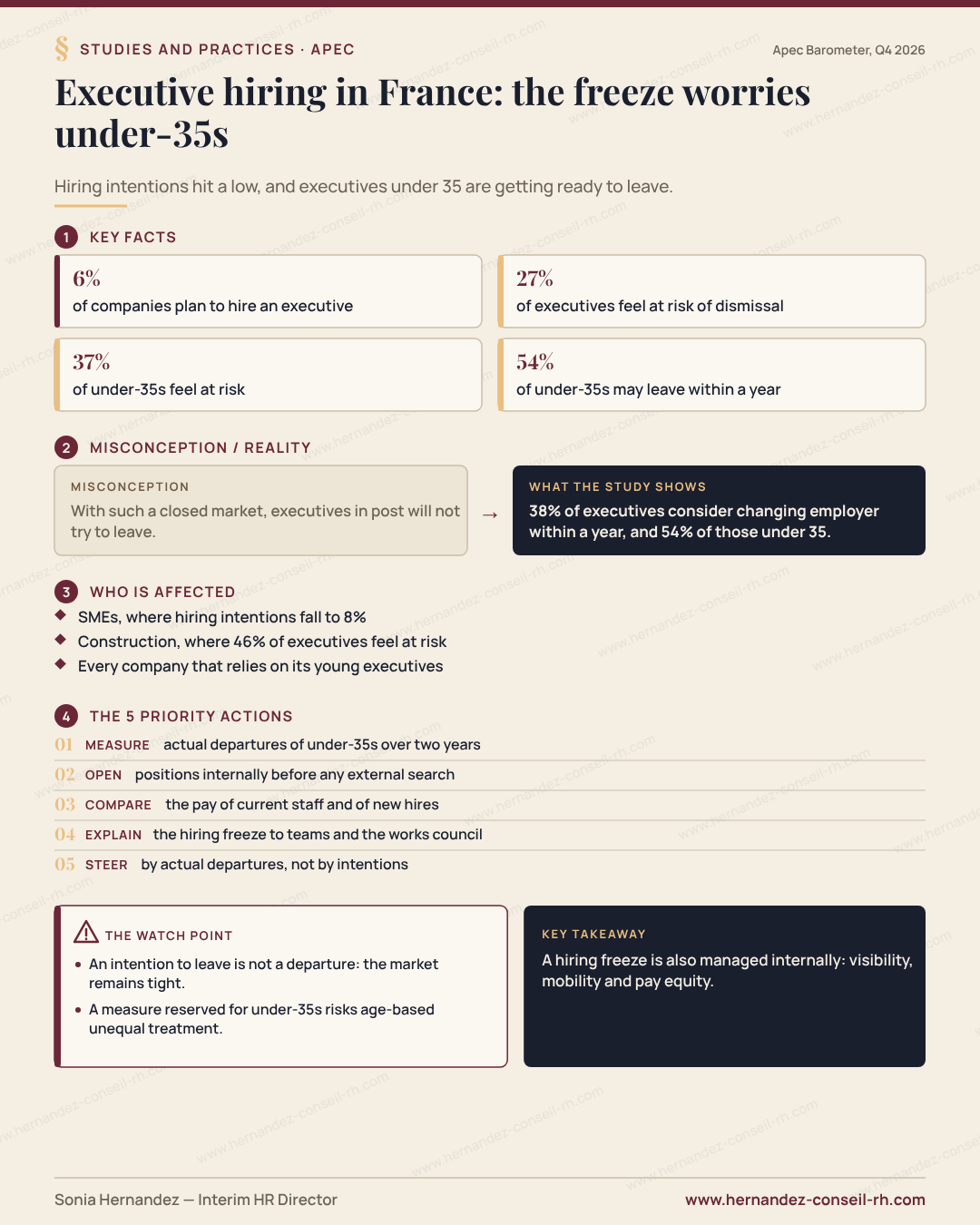
The Q4 2026 barometer from Apec (in French), France's executive employment agency, published on November 17, is based on two surveys conducted from September 1 to 15, 2026 among 2,000 executives and 1,000 companies. It describes a two-way movement. On one side, companies are sharply cutting their plans to hire executives, down to 6%, which Apec describes as a record low. On the other, executives are worried about their jobs: 27% feel at risk of dismissal, up 3 points in a year.
Young executives are the hardest hit. Among under-35s, the feeling of being at risk reaches 37%, up 7 points year on year. Their intentions to move are rising at the same time: 20% are considering changing employer within three months, and 54% within twelve months. Executives as a whole remain more stable, with 14% intending to move within three months and 38% within twelve months.
For an HR department, the combination is tricky: fewer hires, so more work for existing teams, and young executives getting ready to leave as soon as the market allows.
What is at stake
Legal
A hiring freeze is not a neutral decision under French employment law. It reflects headcount choices that belong in the works council (CSE) consultation on strategic orientations, which covers their consequences for jobs, occupations and skills, under Article L. 2312-24 of the French Labor Code (in French). Retention measures, for their part, must rest on objective criteria: reserving a scheme for employees under 35 would risk unequal treatment based on age.
Labor relations
A sense of insecurity weighs on engagement. Executives' confidence in their company's future stands at 69%, and only 21% are confident about the country's economic outlook. When departures are not replaced, the workload shifts onto existing teams, which can trigger further departures.
Financial
The economic climate explains companies' caution: according to Apec, confidence in order books is down 5 points and cash is getting tighter in SMEs. But an unplanned departure also has a cost, made up of recruitment, vacancy and the replacement's learning curve. The most recent executive hire took about twelve weeks on average, according to the Apec study on 2026 recruitment practices (in French).
Reputational
Young executives compare employers. A company that freezes hiring without explaining why, or that lets its teams absorb the workload with no prospects, risks a lasting reputation among the very people it will want to attract when hiring resumes.
Who is affected
Directly affected are:
- SMEs, where the share of companies planning to hire an executive falls to 8%, down 4 points in a year,
- construction, where executive hiring intentions drop to 1% and 46% of executives feel at risk,
- companies relying on their executives under 35 for succession,
- and finance departments setting the 2027 pay budgets.
Mid-size and large companies are less affected: their hiring intentions are almost flat year on year (+1 point). The 6% figure covers all the companies surveyed, where small businesses carry the most weight.
What to do
Action plan to get through the hiring freeze without losing young executives:
- pull from the HRIS the resignations and mutually agreed terminations of executives under 35 over two years, by job and by team,
- identify, with managers, the profiles whose departure would be hardest to make up for, on the basis of job and skills criteria,
- open available positions internally before any external search and make the internal mobility rules clear,
- compare the pay of current executives with that of the latest hires at the same level before the 2027 reviews,
- explain the hiring freeze, its likely duration and the rule for replacing departures, to teams and to the works council alike,
- and track the voluntary departures that actually occur rather than stated intentions.
The approach works best with internal data rather than national averages: the barometer gives the trend, not each company's situation.
Watch points
- an intention to leave is not a departure, especially while the market remains tight,
- the increases cited are measured year on year; compared with June 2026, the situation is fairly stable,
- age can inform the diagnosis, but must not be a criterion for access to a measure,
- the sector figures rest on subsamples whose size is not published in the summary,
- and a poorly explained hiring freeze feeds the very sense of insecurity it should be reducing.
In-depth analysis
What the data says
Apec's quarterly barometer measures, on the one hand, the share of companies planning to hire at least one executive and, on the other, the sentiment and intentions of executives in post. The surveys for this wave were conducted from September 1 to 15, 2026, before some of the fall budget announcements. The summary and the full report (in French) are freely available.
The published changes are year on year. Compared with the previous wave, carried out in June 2026, Apec's summary of September 22, 2026 (in French) showed 7% of companies ready to hire, 28% of executives feeling at risk, 38% among under-35s, and already 38% intending to move within twelve months. The trend is therefore a stabilization at a degraded level rather than a further fall. Executives' confidence in the country's economy remains low, at 21%.
What practitioners say
At the time of writing, no published commentary on this wave was available. Three recent sources nonetheless help to read it.
Apec, "Quelle mobilité professionnelle pour augmenter son salaire ?," July 17, 2026. Drawing on Apec's 2025 pay barometer, this article (in French) reports that 70% of executives who changed jobs within their company got a raise, compared with 64% of those who changed employer and 49% of those who stayed put. Internal mobility thus emerges as a credible lever.
Apec, "Pratiques de recrutement de cadres 2026," May 2026. The study (in French) finds that the most recent executive hire took about twelve weeks on average and that recruitment difficulties have eased, as the balance of power has shifted toward employers.
Valérie Forgeront, L'inFO militante (Force ouvrière), March 31, 2026. This union reading (in French) of an earlier wave of the barometer already noted the gap between rising hiring intentions and actual hiring at record lows, persistently low morale among executives and a slower entry into work for young graduates.
Limits and open questions
The barometer measures intentions and perceptions. Several limits call for caution:
- an intention to leave does not automatically turn into a resignation, especially when the market is tight,
- sector differences, such as the 46% of executives feeling at risk in construction, rest on subsamples whose size is not given in the summary,
- the date when hiring will pick up, which determines the real risk of departures, is unknown,
- and the framework for France's upcoming pay transparency rules, which will make gaps between current staff and new hires more visible, has yet to be settled, as explained in our insight on the bill.
Expected cost and benefit
No public source sets the cost of a departure; the calculation below is an illustrative example only, and every assumption can be adjusted.
Cost of losing a young executive paid 50,000 euros gross a year, or 72,500 euros including employer charges at a 45% rate: 10,000 euros in recruitment fees (20% of gross salary), 6,650 euros of uncovered vacancy over four weeks (20 days at 332.57 euros), 18,125 euros for the learning curve (six months at 50% productivity) and 3,625 euros of extra salary cost for the replacement in the first year. The total comes to about 38,400 euros, more than half the annual employer cost.
Benefit of a targeted program in a mid-size company with 60 executives under 35: if the voluntary turnover rate falls from 12% to 8%, the company avoids 2.4 departures a year, about 92,200 euros. The program costs 58,500 euros, split between career reviews (15,000 euros) and targeted pay adjustments for 15 people (43,500 euros including charges). The net gain is about 33,700 euros, and break-even is reached at 1.5 departures avoided. Tracking should focus on actual departures, not intentions.
The employee representatives' perspective
For employee representatives, the barometer first describes insecurity: 27% of executives feel at risk of dismissal, 37% of under-35s and 46% in construction. The hiring freeze is not neutral, because it reflects headcount choices that fall within the consultation on strategic orientations. Representatives can use that consultation to ask for the number of unreplaced departures, their breakdown by department and the trend in workload, and to propose alternative orientations, to which the board must give a reasoned response.
A targeted retention policy will be viewed with suspicion if it stays confidential. Representatives will see a risk of unequal treatment between the profiles singled out by management and other employees, especially older executives or non-executive staff carrying the same extra workload. They will ask for written criteria for internal mobility and pay adjustments, and for a quantified review broken down by age and gender.
Cross perspectives
The group HR director's view
The figure that worries me is not the 6% but the 37%: more than one in three executives under 35 feels at risk, and more than half of them are considering changing employer within the year. A poorly explained hiring freeze feeds both signals. I would start by measuring resignations and mutually agreed terminations in this population over two years, then review key profiles with managers ahead of the 2027 pay round. Internal mobility remains the least costly lever, provided positions are genuinely opened internally.
The Comp&Ben expert's view
Apec's data on 2025 pay offers a useful benchmark: executives who changed jobs within their company were more often given a raise than those who changed employer. Internal mobility is therefore no consolation prize. Before the 2027 reviews, I would compare the pay of current executives with that of the latest hires at the same level, because that is often where gaps open up at the expense of existing staff. Upcoming pay transparency rules will make them more visible: better to have measured and corrected, or justified, them beforehand.
The CFO's view
Confidence in order books is falling and SMEs' cash positions are getting tighter. In this context, I will not sign off on a general retention budget. I can, however, fund a targeted measure if I am shown what a departure costs and how many departures we hope to avoid. In the example above, the program breaks even at 1.5 departures avoided out of sixty young executives. I will ask for the tracking indicator to be the voluntary turnover rate actually observed, not the intentions stated in surveys.
The union delegate's view
Employees read these figures differently from management. A young executive who feels at risk wants visibility on their job first, before any retention scheme. When a company freezes hiring, the workload shifts onto existing teams, and that shift often accelerates departures. We will ask that the consultation on strategic orientations set out planned executive headcount, the rule for replacing departures and the criteria for access to internal mobility, so that retention does not boil down to a few profiles chosen without any known rule.
The works council's chartered accountant's view
These national trends need to be checked against the company's own data. The economic, social and environmental database provided for by Article L. 2312-18 of the French Labor Code (in French) gathers the information needed for the recurring consultations, including the one on social policy, working conditions and employment, which covers in particular changes in employment and skills under Article L. 2312-26 of the French Labor Code (in French). For that consultation, the works council (CSE) may be assisted by a chartered accountant under Article L. 2315-91 of the French Labor Code (in French), and Article L. 2315-80 of the French Labor Code (in French) then places the cost of the assignment on the employer. I would ask for managerial hires and departures by age group and by reason over three years, the rate at which departures are replaced, and how the pay of managers already in post has evolved compared with recent hires. The committee can base a reasoned opinion on these figures far more than on a national survey.
Sonia Hernandez, Interim HR Director — November 23, 2026
General information current as of November 23, 2026; it does not constitute legal advice.