Contents
The problem
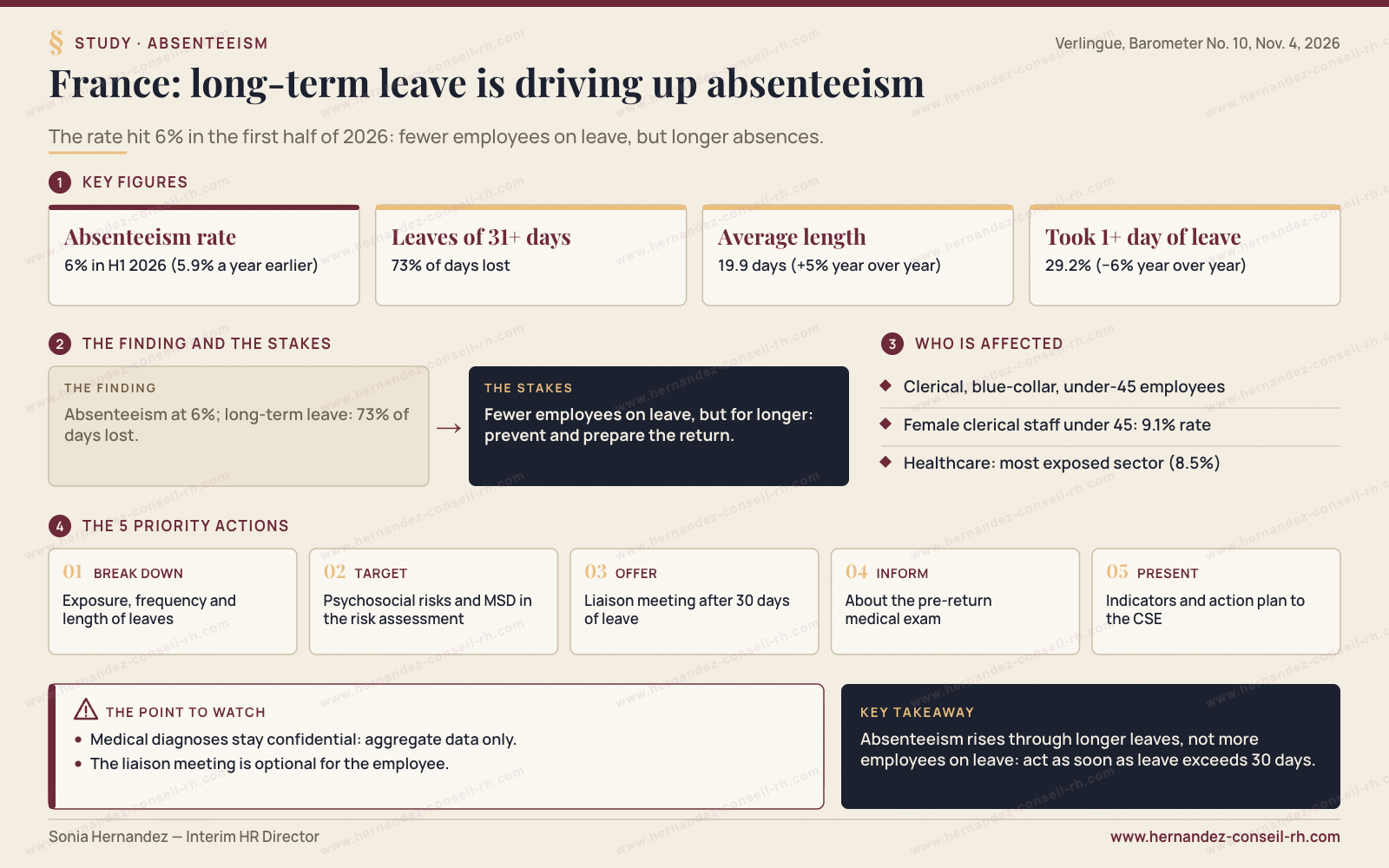
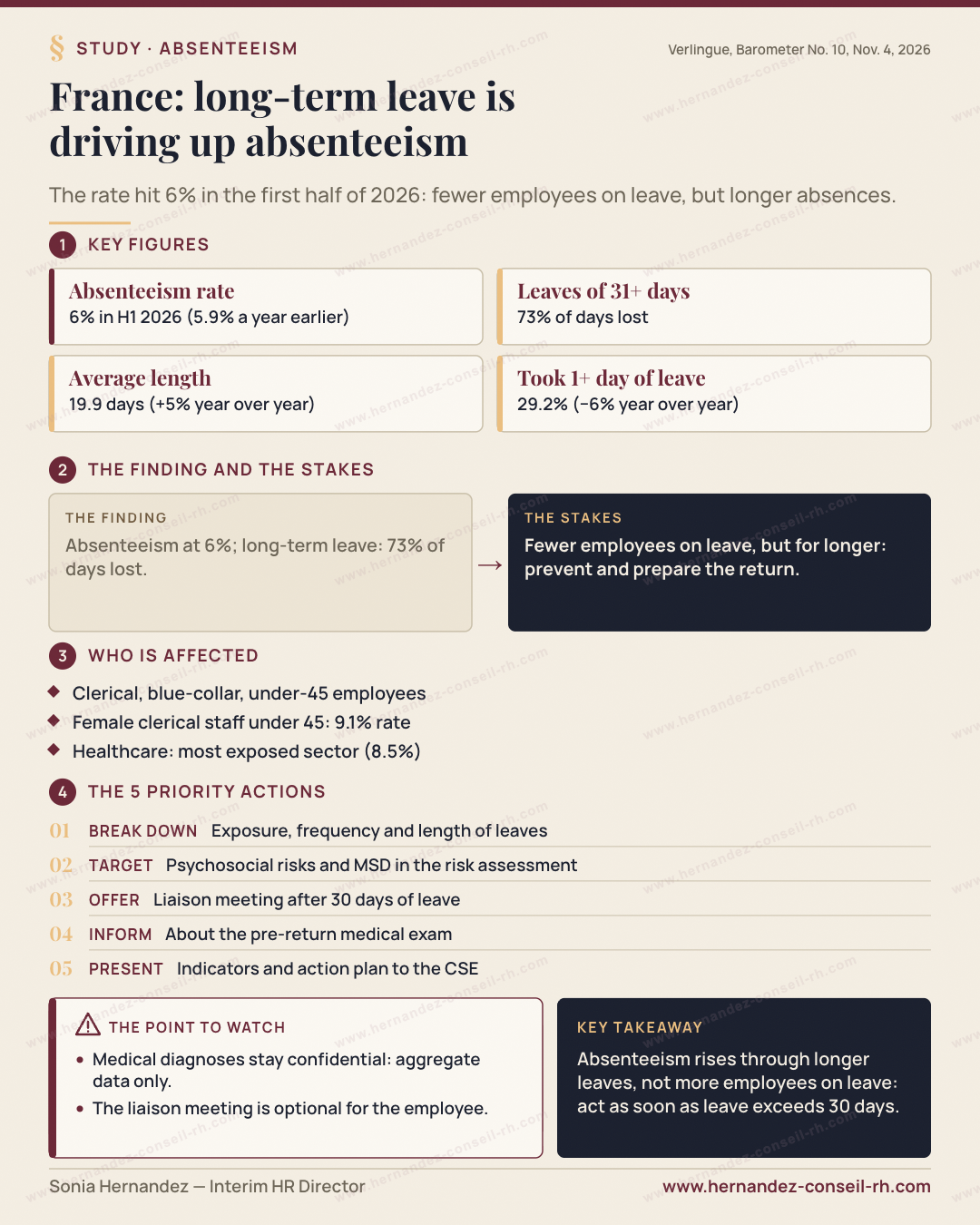
On November 4, 2026, insurance broker Verlingue released the 10th edition of its Absenteeism Barometer (in French). In the first half of 2026, the absenteeism rate reached 6%, compared with 5.9% a year earlier and 5.5% in the first half of 2024: up 2% in one year and 9% in two years.
Two figures capture the paradox. The share of employees who took at least one day of sick leave fell to 29.2% (down 6% year over year). Yet the average leave grew 5% longer, to 19.9 days, and each absent employee had 1.59 leaves on average, up from 1.53. Absenteeism is no longer rising because more people are absent, but because absences last longer.
Leaves of 31 days or more now account for 73% of days lost (71% a year earlier, 70% two years earlier). Exposure to these long-term leaves rose from 6.42% of employees in the first half of 2024 to 7.05% in the first half of 2026, and the increase is limited to employees under 40. Among the identifiable conditions behind leaves longer than 60 days observed in 2025, psychosocial risks (PSR) account for 28% and musculoskeletal disorders (MSD) for 24%, with average durations of 195 and 209 days.
What is at stake
Legal
Employers must take the measures needed to protect workers' physical and mental health under Article L. 4121-1 of the French Labor Code (in French), following the general prevention principles of Article L. 4121-2 of the French Labor Code (in French), which expressly cover work organization and harassment. The weight of PSR and MSD in long-term leave points directly to the mandatory occupational risk assessment (DUERP) required by Article L. 4121-3-1 of the French Labor Code (in French).
Labor relations
The longer a leave lasts, the harder the return. Long-term leave exposes employees to lasting exclusion from work and teams to a sustained extra workload, which can itself trigger new absences. The topic also belongs in collective dialogue: employee representatives expect shared data and a prevention plan, not just more checks.
Financial
According to Verlingue, the cost of employer-paid sick pay rose 4% between the first halves of 2025 and 2026, and indirect costs (replacements, administration and lost productivity) can amount to two to four times that direct cost.
Reputation
High, persistent absenteeism is read, inside and outside the company, as a proxy for working conditions: it weighs on employer attractiveness, especially in occupations already facing labor shortages.
Who is affected
The gaps between populations are wide:
- women: 7.6% (up 4% year over year), compared with 4.6% for men (down 1%),
- clerical employees: 7.7% (up 5%); blue-collar workers: 7.7% (stable),
- managers and professionals: 2.9% (up 3%), with a marked rise in average leave duration,
- female clerical employees under 45: 9.1% (up 8%), with 42.4% taking at least one day of leave and 1.92 leaves per absent employee,
- and employees under 45, the only age groups where the rate is rising.
By sector, healthcare remains the most exposed (8.5%), ahead of food processing (6.8%), transportation (6.5%) and retail (6.2%). Long-term leave linked to PSR is more common among managers; MSD mostly affect non-managers, and their share increases with age.
The newest signal concerns younger employees: exposure to long-term leave is rising only among those under 40, and by 10% year over year among those under 30. A prevention policy designed only for older workers misses part of the problem.
What to do
- break the company's absenteeism down into exposure, frequency and duration, by population and site, using payroll data and the monthly social security filing (DSN),
- add primary prevention actions to the risk assessment and prevention plan, targeting PSR (workload, management and organization) and MSD (workstations, movements and pace),
- systematically tell employees on leave for more than 30 days that they may request a liaison meeting, provided for by Article L. 1226-1-3 of the French Labor Code (in French) and available after thirty days of leave under Article D. 1226-8-1 of the French Labor Code (in French),
- remind them that they may see the occupational physician for a pre-return examination, provided for by Article L. 4624-2-4 of the French Labor Code (in French) and available for leaves longer than thirty days under Article R. 4624-29 of the French Labor Code (in French),
- prepare the return with the occupational health service (SPST): workstation adjustments and, if prescribed, a therapeutic part-time arrangement with daily benefits under Article L. 323-3 of the French Social Security Code (in French),
- and present the indicators and action plan to the works council (CSE) for its input.
Points to watch
- medical diagnoses remain confidential: the company works with aggregated data, never with an identified employee's condition,
- the liaison meeting is optional for the employee: under Article L. 1226-1-3 of the French Labor Code, no consequence may be drawn from a refusal,
- a return-to-work medical examination is required after 60 days of absence for non-occupational illness; as amended by Decree No. 2026-503 of June 12, 2026, Article R. 4624-31 of the French Labor Code (in French) no longer requires it, unless the occupational physician, the employer or the employee asks for it, when a pre-return examination held within the thirty days before the return found no workstation or working-time adjustment necessary (for sick notes issued since the decree took effect),
- rates published by different barometers cannot be compared directly, since definitions differ,
- and a policy focused on checks without prevention may damage labor relations without reducing long-term leave.
In-depth analysis
What the data show
The press release discloses neither the size of panel No. 10 nor the calculation formula. The method described in edition No. 5 (May 2024) (in French) relies on the monthly social security filings of the broker's health and disability insurance clients (over 440,000 insured employees at the time), with a rate computed per calendar day by dividing full-time equivalents (FTE) absent by FTE under contract. It covers ordinary illness, therapeutic part-time work and occupational accidents and diseases.
Other sources agree on the trend, not the level. The Marsh barometer of October 7, 2026 (in French), based on over 550,000 insured employees, reports 5.7% for 2025 and an average leave of 23.2 days. On the public finance side, French Senate Finance Committee opinion No. 747 of June 16, 2026 (in French) notes that daily sickness benefits rose 4.6% in 2025, to 17.8 billion euros for the health and occupational injury branches.
What practitioners say
Verlingue, guidance note on absenteeism indicators and prevention levers, November 4, 2026. The broker urges employers not to reduce absenteeism to a single rate (in French) and to read exposure, frequency and duration together. It names MSD and mental health as priority prevention areas given longer leaves.
Marsh France, press release, October 7, 2026. In the Marsh barometer (in French), its head of technical engineering says it would be unrealistic to expect a one-off measure to halve absenteeism durably within weeks; in his view, a methodical and consistent approach can, however, move the needle.
Éditions Tissot, April 21, 2026. Discussing the AXA Datascope 2026 (in French), the editors stress that long-term leave explains most of the rate and that psychological disorders are its leading cause, rising sharply among younger employees.
The major French labor law journals, available by subscription only, could not be consulted.
Limitations and open questions
- the panel reflects a broker's client portfolio, not all French employers,
- a half-year rate is not comparable to an annual rate: the 9th barometer (in French) reported 5.8% for full-year 2025,
- the breakdown by condition covers only "identifiable" leaves longer than 60 days,
- and the press release calls life sciences the lowest sector (4.5%) while giving 4.3% for construction, which should be checked in the full study.
Expected costs and gains
Statutory sick pay top-up applies to employees with one year of service under Article L. 1226-1 of the French Labor Code (in French): 90% of gross pay for thirty days, then two-thirds for thirty days under Article D. 1226-1 of the French Labor Code (in French), after a seven-day waiting period for ordinary illness under Article D. 1226-3 of the French Labor Code (in French), plus ten days per full five years of service beyond the first year, up to 90 days per period, under Article D. 1226-2 of the French Labor Code (in French). Daily social security benefits, and the employer-funded share of disability insurance benefits, are deducted under Article D. 1226-5 of the French Labor Code (in French). Industry-wide collective agreements are often more generous.
Illustrative case (working assumption): a 400-employee company with a 6% rate has 24 FTE absent on average. If 73% of days lost come from leaves of 31 days or more, about 17.5 FTE are absorbed by long-term leave. Cutting those days by 10% frees about 1.75 FTE. The direct gain is the sick pay and disability insurance benefits avoided on those days; according to Verlingue, indirect costs can amount to two to four times the direct cost of sick pay.
The employee representatives' perspective
In companies with at least 50 employees, the works council has several levers:
- analyzing occupational risks and proposing harassment prevention actions, which the employer may refuse only with stated reasons under Article L. 2312-9 of the French Labor Code (in French),
- issuing an opinion on the annual prevention report and program, and proposing priorities under Article L. 2312-27 of the French Labor Code (in French),
- being consulted on measures to keep people with chronic progressive conditions at work under Article L. 2312-8 of the French Labor Code (in French),
- and devoting at least four meetings a year, in whole or in part, to health, safety and working conditions under Article L. 2315-27 of the French Labor Code (in French).
The employer's best response: share aggregated indicators by population, co-design the prevention plan and report on its execution, rather than addressing absenteeism through checks alone.
Cross perspectives
The CFO's view
According to Verlingue, the 4% rise in sick pay costs stems from longer leaves, only partly offset by the lower share of absent employees. Disability insurance budgets and provisions should therefore track the share of long-term leave, which accounts for 73% of days lost, rather than the overall rate alone.
The occupational physician's view
The pre-return examination allows recommendations on workstation adjustments, redeployment or training under Article R. 4624-30 of the French Labor Code (in French). The occupational health service's job-retention unit under Article L. 4622-8-1 of the French Labor Code (in French) is the contact to involve early.
The works council expert's view
An average rate hides at-risk groups: female clerical employees under 45 are 45% more likely than the panel average to have taken at least one day of leave. Analysis and the prevention program should be built population by population.
Sonia Hernandez, Interim HR Director — November 9, 2026
General information current as of November 9, 2026; it does not constitute legal advice.